Welcome to the News section of the iNSiGHT Ornithology website (https://www.simoncherriman.com.au/). This blog contains updates about various things I've been up to, interesting environmental issues and observations I make regularly while going about my day. It is designed to be fun AND educational, and inspire you about our wonderful natural world. Happy reading!

Friday, 30 September 2016

Eagle Breeding - Success and Failure


Wedge-tailed Eagle nests in the Perth Hills are normally built high up in one of the largest trees available, which gives the birds a good view over their territory. Large trees usually have at least one sturdy fork in which the birds can construct their massive stick platform, but such trees are not necessarily entirely stable. While checking on one pair of eagles recently, I parked at a familiar monitoring location - a roadside parking bay - and peered up to the nest with binoculars. Despite being familiar with the site, I was unable to see the eyrie right away, and I wondered if the canopy of trees in the foreground had grown up and obscured my view. After several minutes scanning, I still had no luck, so I decided to walk up to the ridge and have a closer look. Judging by observations of an incubating adult from earlier in the season, I anticipated the nest should contain a month-old chick.

While walking up the steep, rocky ridge towards the nest tree, I pondered the whereabouts of the nest, casting my mind back to last breeding season, when it was clearly visible. Why couldn't I see it? I then remembered the entire nest tree was dead, and suddenly realised what must have happened. I had a vision of what lay in front of me, and sure enough, as I neared the site, I noticed my instinct was right.


The entire nest tree, a very large, straight but entirely dead Marri, lay on the forest floor. Its rotted root-system had prized up a large chunk of earth, and as I inspected the ground, I realised the relatively wet weather this year must have made the ground soft, and strong winds (not to mention a very heavy eagle nest!) caused it to topple over. As you can see in the above image, the nest-tree still has bark, indicating it has probably only died in the last 2 years. I've noticed that mature eucalypts like this seem to be 'dropping off the perch' at an increasingly frequent rate, a result of increased stress during the hotter, drier summers associated with a changing climate.

The grim news was that I confirmed the nest had indeed contained an eaglet aged about 5 weeks, evident from its remains found amongst the mass of collapsed branches and nest lining.
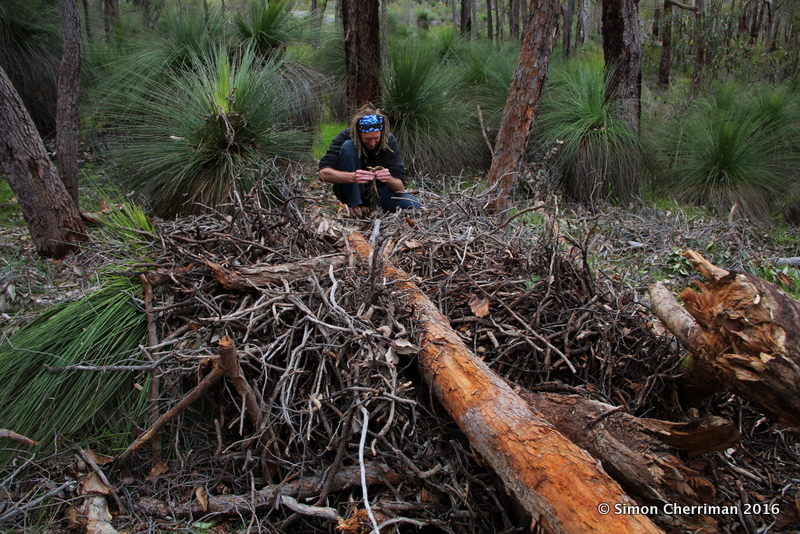
Examining the remains of a 5 week-old eaglet which died when the nest came crashing down.

The eaglet's leg can just be made out in the remains of the giant, collapsed eyrie.


This was an unfortunate discovery as the eaglet was born in a productive territory with ample food, so would have had every chance of fledging. Nevertheless, such events emphasise the delicate balance between life and death, and prove that not every bird which breeds fledges chicks in the 'happily ever after' scenario that humans often perceive. They are an interesting and important part of ongoing research.

Unlike the above site, however, most other eagle nests in the hills have been successful this year, and it has been exciting to commence ringing/banding the first chicks of the season. This is now the second year of the colour-marking study which is part of a long-term research project investing the movements and survival of juvenile Wedge-tailed Eagles, which commenced last year. I have worked towards setting up such a study ever since I found the first Perth Hills wedgie nest over 15 years ago, and put many hours into obtaining the appropriate licenses from State and Federal Government departments, so it is a fantastic feeling to know the study is off the ground at last!!


I climb to each nest using rope-access techniques, and the chick is carefully secured by the talons and placed into a handling bag, then lowered to the ground. This allows us to perform all the necessary tasks beneath the tree and on a flat place which doesn't sway around in the breeze! Once inside the bag, the eaglets normally sit on their haunches until they are taken out and held firmly by an assistant.

Mick holds the eaglet while the footspan is measured.

It was brilliant to have my good friends Mick and Rianna, and their boys Jarrahn and Bhodi, helping with the first eaglets of the year. Mick has been reporting eagle sightings and assisting with monitoring of nests for many years now, so it was a pleasure to head bush with him and his family, and this also created a great opportunity for an educational activity for the next generation of ornithologists!

The first nest we visited had a single chick aged about 8 weeks. It was in very healthy condition and had been recently feeding on a freshly killed Australian Raven (Corvus coronoides), whose carcass lay on the nest cavity.


At the second site east of the Mundaring Shire, we were delighted to discover a brood of 'twins', aged between five and six weeks. These birds were in a nest built high in a dead Marri tree and had an amazing view over the surrounding Wandoo woodland. Wedgies normally lay two eggs but only rear one chick, as the second either doesn't hatch or dies in the first few weeks of nest life. After the nesting failure described above, it was wonderful to have a 'replacement' turn up so quickly!


7 year-old Jarrahn was delighted to see this female eaglet up close.

The first part of processing eaglets involves placing two metal rings/bands around the their legs: a stainless-steel ring from the Australian Bird and Bat Banding Scheme, and a specially designed aluminium colour-ring fitted with pop-rivets, coloured yellow which is unique to my Perth region study area. I have learned the method of applying such bands from Golden Eagle researchers in Scotland, where I spent time volunteering and gaining experience earlier this year, and it has been fantastic to carry on with the same type of work back home.


After ringing/banding, several measurements are taken to record the birds' morphometrics and help us determine their sex. Female eagles have a larger head and a much broader footspan than males, and this difference is apparent after the age of about one month.

Measuring the head-bill length. The long cere indicates this bird is a female.
Measuring the rear talon (halux). Juvenile talons are pin-sharp as they haven't yet been worn.

The ringing and measuring usually takes about 15 minutes, and we carefully monitor the birds to ensure they remain calm throughout. A key difference I've noticed between wedgie and goldie chicks is their personality, with the latter being much calmer overall, sitting quietly and allowing their measurements to be taken without moving much. Wedgies on the other hand sit up in a threat display to warn of any would-be predator (or scientist!) and often strike with their feet at anything that moves beneath them. For this reason, it is safer for the birds and us handlers if they are held firmly but gently during the process.

When we have recorded all the necessary information, the birds are again placed in the handling bag and carefully hoisted back to be returned to the nest cavity. The usual reaction is for chicks to go back on the nest and immediately adopt a defence posture, spreading their wings to make themselves look bigger. This is a good sign that normal behaviour has resumed, and after taking a few photos, I descend the ropes and leave them in peace.

Eagles really are remarkable creatures, and such important parts of our natural heritage. They captivate people with their majestic, soaring flight and inspire us with their almighty powers of vision and capabilities of predation. But they are often simply just there, and we don't necessarily know exactly what they (in particular, young, non-breeding birds) need to ensure their survival. It is for this reason I am driven to continuing research to find out as much as possible about their ecology, and fill knowledge gaps regarding juvenile dispersal. Where will these yellow-ringed birds end up? Keep your eyes peeled, and you might one day be able to tell me!

If you do see a Wedge-tailed Eagle bearing metal leg rings/bands, please photograph it, record the time, date, GPS location, and if possible, the 3-digit colour ring number, and contact me to report this information.


Thursday, 22 September 2016

Sacred Heart Primary


Today I volunteered a couple of hours and visited Sacred Heart Primary School to talk to the children about researching eagles, other wildlife, and the importance of conserving biodiversity. It was wonderful to see so many smiling faces, and also to learn how much some children knew about local species! I feel it is most important to inspire young children to value our unique wildlife, especially in the Perth Hills where we have so much to protect, so I am always keen to jump at an opportunity to speak and hopefully inspire the next generation.

Sunday, 18 September 2016

Lesmurdie Cockatoos


A stones throw from the house where I spent the first 6 years of my life, in the beautiful Perth Hills suburb of Lesmurdie, is a small patch of remnant Jarrah and Marri forest managed by a group of friendly locals. Among them is David Ryder, an old family friend who I've known for over 25 years and someone who shares my passion for collecting materials that many would deem 'rubbish,' and turning them into something more useful (like the wildlife habitat we make in Re-Cyc-Ology Project workshops!). David has recently been obtaining old pieces of PVC storm-water pipe and turning them into nesting boxes for threatened Black Cockatoos, similar to the 'Cockatubes' designed and manufactured by Serpentine-Jarrahdale Landcare. Today I had the privilege of visiting David, Darrell and other members of the Friends of Vernallen Reserve, who were keen to have a couple of the cocky boxes installed, and who had agreed to swap some of my tree-climbing skills for some delightful afternoon tea!

The group had spent the morning busily raking leaves and collecting twigs to reduce the flammable fuel load in preparation for the upcoming bushfire season. Such work was coordinated by the local community and it was fantastic to see a friendly bunch of people combining forces to output such an efficient work-rate. It made me wonder why more energy isn't spent on pushing for this type of 'grass-roots' approach to fire management in other parts of the Perth Hills. Instead, we seem in many places to have a feeling that government authorities should manage public lands, even though we all live in and benefit from a lifestyle among the forest.

The second cockatoo nest-box is hoisted into place.

I chose two suitable trees in which to install the nest-boxes - one Jarrah and one large Marri - and enjoyed showing the group a safe method of hoisting them up and hanging them in the canopy, while at the same time answering questions about the plight of our endangered cockatoos, and what is being done to help their cause. You can read more about the success of my wooden cockatoo nest-boxes in the Mundaring Shire at this news post.

It was wonderful to see the boxes go up, and know a great group of locals is interested in doing their bit to help.

David, Darrell and some short bloke they found in a tree with a nesting box!!

Friday, 12 August 2016

Kookaburras and Predation


This morning while sitting on the verandah with a cuppa, I was gazing at last night's dew thawing out in the morning sun, when I saw a Kookaburra (Dacelo novaeguineae) suddenly dive from a tree into some tall grass. It emerged with a frog and promptly flew to perch on a large rock and kill its prey using a well-perfected kingfisher technique: multiple 'whacks' against a hard surface.


As an environmental educator I am often asked about the impact Kookaburras have on native wildlife in south-west Western Australia, where this species is introduced. It is true they do kill a variety of vertebrates, like the unfortunate Motorbike Frog (Litoria moorei) shown above, as well as other frogs species, reptiles, and the nestlings of small birds like the Splendid Fairy-wren (Malurus splendens). However, the important thing to consider is not whether or not Kookaburras eat certain animals, but what the overall effect of this eating on the prey species is. Like most predator / prey scenarios, the situation is complex, but I suspect Kookaburra impact is strongly related to the habitat structure where they live. Dense cover will provide refuge for small vertebrates and in many cases allow them to persist, despite the presence of Kookaburras. Kookaburra hunting also cannot be considered in isolation, because the presence of other predators (for example raptors, large snakes and roaming cats) undoubtedly affects the abundance of small animals too.

While conducting a variety of environmental education activities, I have noticed there is a widespread misunderstanding about the concept of predation. Quite a few people I've met actually dislike predators because they kill other animals! Humans like to sympathise with prey species, because for some reason we feel that everything should survive, especially if it is an animal deemed (by mainstream perception) to be 'cute and cuddly'. But the fact is, predation is a completely natural part of any ecosystem, and a vital process in its functionality. It is perfectly normal for animals to die! When eaten, prey animals pass on the energy in their bodies to predators in the same way that grass passes its energy to a herbivorous kangaroo, so a good way to help 'cope' with witnessing acts of predation is to rejoice at how that transfer of energy is helping another creature. And ultimately these predators are killed too - by each other, unforeseen weather, or old age - and their energy is then recycled in the environment.

I'm not defending Kookaburras, because as a biodiversity conservationist I strongly support to conserving animals that are native (and especially those endemic) to this unique part of the world. A significant part of helping such species is controlling invasive pests. Cats (Felis catus) and European Foxes (Vulpes vulpes), for example, have been shown through a multitude of scientific research to have negative impacts to local native fauna. But I am yet to see any scientific studies which document actual (rather than perceived) threats of Kookaburras to wildlife. I think it would be useful to have research that measures the outcomes of controlling these introduced species so we can learn more about their role in south-west WA. If you know of any such research, please comment below!

It is also important to emphasise that the cumulative impact of the many threats imposed on urban and peri-urban ecosystems by humans is significant, and probably far greater than the impact of any single predator (except, perhaps, cats, which are both feral and domestic and kill numerous native animals every night). In many ways, we can be considered to blame for potential Kookaburra impacts by clearing native understorey vegetation from the land we occupy, to create (at least, in the Perth Hills), a 'comfortable, hobby-farm lifestyle,' and in doing so, reducing protection for the smaller vertebrates that fall victim to these giant kingfishers. Humans are part of every ecosystem, and ecology is a complex field of study. You might even say it's a mouthful.

Friday, 29 July 2016

More Cockatoo Boxes for Stoneville


After last year's successful breeding by Ngolyenoks (Carnaby's Cockatoos) in one of the artificial nest-boxes installed after the 2014 bushfires, the Mundaring Shire has shown great enthusiasm to continue supporting the species' conservation with the provision of three more boxes, in the hope that this will increase the number of pairs of cockatoos that breed in this reserve. Two additional nest-boxes were donated by local singer-songwriter Storme, who conducted a crowdfund for cockatoo nest-boxes several years ago. Last week I had the pleasure of installing all five boxes, and it was great to be back in local bushland and admire the continuing post-fire regrowth, which, as you can see above, is looking very lush after a decent rainy start to the year!

Spot the Simmo! Climbing a tall, burned Marri to set up ropes for nest-box installation.

The installations had me hanging in some wonderful Jarrah and Marri trees, which were tall and healthy but still very young. In terms of habitat value, the addition of these boxes ages their host trees significantly - it would take about 500 years for the Jarrah tree below to form a hollow the same size as the box attached to it. This tree is probably only about 80 years old.

A Jarrah hardwood entrance matches the red-brown bark of the host tree.

All my nest-boxes designed for Black Cockatoos include sturdy sacrificial chewing-blocks placed around the vertical entrance, as well as one or two hardwood posts placed inside. This material is used by the cockatoos to tear off 'cigar-shaped' splinters of wood, which are dropped on the nest-hollow chamber, creating a well-drained substrate on which eggs are laid. Other cockatoo nest-box designs (e.g. those made from PVC pipe) use a simple wire ladder, made from 40mm weld-mesh and measuring about 150mm wide. Having found many examples of non-target species (e.g. ducks, smaller parrots and bats) becoming trapped inside these boxes and killed (the mesh isn't fine enough to allow them sufficient grip to climb out), I try to ensure my wooden boxes are fitted on at least three sides with a wire mesh ladder with squares no larger than 20mm, to ensure all fauna can enter and exit the boxes safely.

Looking down inside one of the newly installed boxes. Note the mesh ladder on 3 sides.

After spending the past five weeks wandering the Scottish highlands and climbing to eagle eyries, it felt wonderful and very healing to be back in the canopy in the Perth Hills again. The cockatoo breeding season is fast approaching so it will be exciting to monitor these new nest boxes later in the year and find out whether more beautiful Ngolyenoks take up residence!

The view from the canopy always gives a wonderful perspective on the bush... and my roof rack!

Saturday, 23 July 2016

Eagle in Sight e-Book: Launched!


In 2009 I started jotting down some short stories about adventures I had during my early years of studying Wedge-tailed Eagles in the West Australian bush. Together with some pictures of eagles and the habitats they live in (of which I have just a few!), they gave the perfect material from which to make a book. Since completing and printing the first draft hard-copy in 2012, I've been exploring various publication options, and I eventually decided that the most efficient way to release this work is as a PDF e-Book. This will allow readers to carry it on any device (e.g. laptop, iPad) and read it wherever they go. On my recent long flight back from Scotland I managed to give this project the last bit of energy needed to send it flying at last! So, today I'm THRILLED to announce that the book I've been working on (among one or two other things!!) for the past 7 years is FINISHED!

Below is the blurb for my Blurb-published e-Book:

"The Wedge-tailed Eagle is the largest Australian bird of prey and the fourth largest eagle in the world. Featuring 18 short stories and dozens of colour photographs, this book communicates the unique natural history of this powerful and secretive predator, though the adventures of one boy as he pursues an eagle interest while growing up in the Australian bush. It aims to give the reader an intimate insight into the life of one of Australia's most magnificent and iconic birds, and in doing so, emphasise the enormous rewards one can enjoy from taking an interest in and engaging with the natural environment."

I hope that eventually I will manage to publish a hard-copy, but for now, this e-version allows me to at least release the work. I'm selling the e-Book for $AU12.00, and the Blurb publication website charges $AU4.99 per copy, bringing the total cost to $16.99. To buy your own copy, simply click on the image below. The Blurb sales page also allows you to view a preview of the book, where you can read two of the chapters as a taster before you take on the whole thing. Happy reading!

  http://au.blurb.com/b/7238266-eagle-in-sight#

Wednesday, 20 July 2016

Quenda: From Pouch to Pavement


After a busy trip in Scotland where I've been assisting raptor researchers with fieldwork for the past 5 weeks, I'm now settling back into life in Perth. A good rainy start to the season of Makuru has set the creeks flowing and local wildlife is thriving in the newly replenished landscape. One animal that has made some frequent and delightful appearances is the Quenda or Southern Brown Bandicoot (Isoodon obesulus), a local native marsupial which is common and doing well here in the Perth Hills. Before I went overseas in June, I noticed one of the resident females had a bulging pouch, and closer investigation revealed this:

A litter of embryonic Quenda suckle in the safety of their mother's pouch.

In the above photo you can easily see the noses of three tiny Quenda, and with a closer look, the whiskered snout of a fourth is visible in the centre. It is amazing to note how well the young grip onto (and stretch) their mother's teats, taking in the all important protein-drink needed for growth and development. This marsupial can give birth to up to six young at a time, but normally there is not enough space in the pouch and it is common for only two or three to survive. This find of quadruplets, however, was very exciting, and made me think from then on that each time I saw the 'single' female, I was actually witnessing five Quenda at once!

Weeks later, I've seen at least two independent (but still small and dinky!) juvenile bandicoots foraging in the garden, and given the timing it follows that these are two animals from the above litter. Yesterday I disturbed one of the juveniles near the shed, and it promptly dashed to hide underneath some old wool-bags.


Yesterday morning while making a cuppa, I saw another juvenile (the same one?) quickly run between two clumps of vegetation about 50 m from the house, and an instant later, another similar-sized one was foraging at the edge of the brick paving outside the kitchen window. It was very exciting to watch it sniff out, grasp and then consume a whole grape which I'd put out for the local parrots :)


As I photographed the Quenda feeding, I noticed a small tick (a natural parasite harmless to the animal) hanging on its right flank. I often get asked by hills residents whether bandicoots bearing ticks should be trapped and the parasites removed, but my advice is always the same: being undergrowth dwellers, parasites are a natural part of the Quenda's ecology and unless the animal is riddled and looking like its health is being impacted, it's best to let nature take its course and leave things be.

It will be interesting to continue observing these beautiful animals over the coming weeks, and see for how long they are visibly active. Juvenile Quenda will be tolerated by adults (especially females) for some weeks or even months after weaning, but eventually they must disperse to search for their own territories, and it is during this time that they become highly prone to predation. After seeing how much effort goes into this new generation of local natives, it would be a great shame to know they'd been unnecessarily eaten by a roaming pet cat. Find out more about how you can help Quenda by reading this fact sheet.

Sunday, 3 July 2016

Treecreepers


While Ewan and I were walking in a patch of woodland today, a small chirping sound from above caught our attention. I knew it was coming from a fledgling songbird, and scanned the canopy in search of any movement. After following the sound for a few minutes, we realised it was actually coming from the ground and being projected upwards in a way that sounded like the source was higher up. Suddenly we noticed a brood of recently fledged Common Treecreeper (Certhia familiaris) chicks, beaks pointed skyward as they tucked up against the upturned root mass of a fallen tree, only a few metres away from a well used walk-trail. They were very well hidden, except for their bright orange mouth-parts which flashed as they opened their beaks to beg for food.


Counting the chicks was difficult due to their camouflaged feathers and the way they were huddled up, but eventually we could see there were five altogether. The adult Treecreepers were close by, making occasional contact calls while gathering food in the treetops. I hid in the grass next to a large pine and waited to see if I could take some family feeding photos.


After doing a few fly-pasts to inspect the new object near their chicks, and landing to make sure their brood was still intact, the adult birds soon accepted me and continued feeding, bringing in a beak-full of insects every few minutes. Then they would zip over to the base of a nearby tree and creep upwards in short bursts, spiraling around the trunk to stay hidden while gleaning prey.

An adult Treecreeper has caught a large mosquito from the canopy.


Then they would fly in and cling expertly to the upturned root mass, using their large claws to grip the rough surface and creep towards the chicks, before dropping down and using a mossy stone below the brood from which to deliver food.


Occasionally, while leaning backwards to face their parents in a desperate begging motion, one of the chicks would tumble town the small slope of the root embankment, then quickly climb and flutter back to its cozy nook with the rest of the brood. I was amazed how determined the chicks were to stay together in their protective huddle. Like the young of most songbirds, these chicks expel faeces in a small, membranous sac which is easy for a visiting adult to collect and carry off to discard away from the nest site. This cleaning activity helps detract attention from the chicks, reducing the likelihood of predators locating and devouring them.

The adult removes a faecal sac discarded by one of the chicks.

The time passed quickly as I watched and snapped photos, before it was time to head home and leave the birds be. It was a thrill to have found and observed this wonderful family of secretive woodland inhabitants. And again it proves that nature is so often 'doing its thing' right under our very noses. We just need to keep our eyes and ears out to make exciting and rewarding discoveries!