Welcome to the News section of the iNSiGHT Ornithology website (https://www.simoncherriman.com.au/). This blog contains updates about various things I've been up to, interesting environmental issues and observations I make regularly while going about my day. It is designed to be fun AND educational, and inspire you about our wonderful natural world. Happy reading!

Sunday, 29 January 2017

Giant Eagles of the Forest


I've recently returned from Tasmania where I spent the last 2 weeks volunteering with University of Tasmania student James Pay, who is also studying Wedge-tailed Eagles for his PhD. Some of James' work has involved satellite-telemetry, so I was thrilled when he gave me the opportunity to visit Tassie and assist with the attachment of transmitters to juvenile eagles, something I have been slowly gaining experience doing since Wallu was satellite-tagged in 2013.

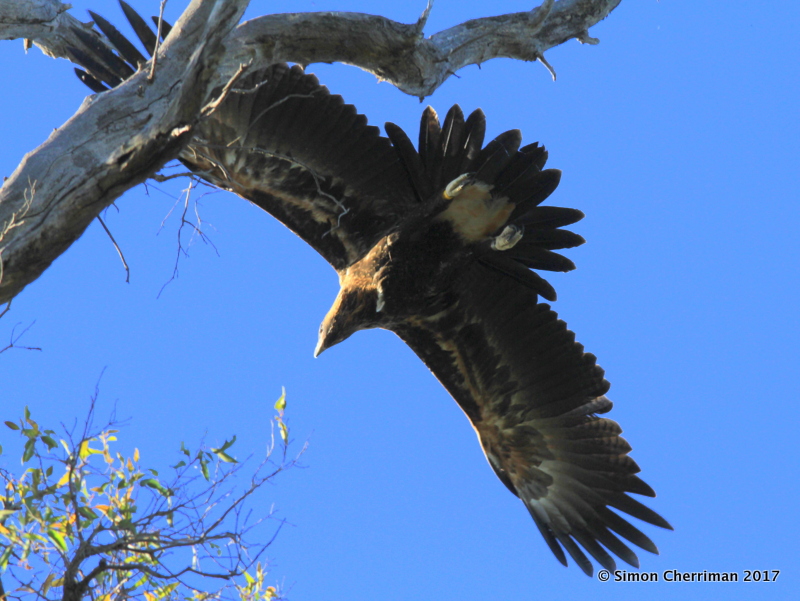
More information is coming soon, but for now I wanted to post a few images of the magnificent bird that is the Tasmanian Wedge-tailed Eagle (Aquila audax fleyii), a subspecies of wedgie that, as I was totally amazed to discover first-hand, is so much bigger than its mainland cousin!

Tasmanian Wedge-tails are normally very wary but this female was an exception to the rule.

The eagle's habitat in this southern-most part of its range is usually tall Eucalypt forest.

Eyries like this one built in a tall Mountain Ash (E. regnans), are very camouflaged in the canopy.

The characteristic pale head and dark bill of a juvenile Wedge-tailed Eagle.

Woldja, an 11-week old Tasmanian Wedge-tailed Eagle that I was thrilled to capture.

Bill Brown holds Woldja while James Pay fits a harness-mounted satellite transmitter to her back.

Woldja's feet were eNORmous (nearly the same size as my hand!) - an adaptation for taking the larger prey animals like possums and paddymelons found in Tasmania.

All juvenile eagles have a pale head but Woldja's was an incredibly beautiful blonde colour.

A beautifully calm 8-week old Wedge-tail with a transmitter being fitted.

The incredible tree-climbing skills of Dave James allowed access to some very high eyries!

Thursday, 5 January 2017

Trails in the Sky


As the warmer season of Birak takes shape and rising thermal air-currents become more frequent, last year's Wailitj / Wedge-tailed Eagle fledglings are beginning to gain experience in the sky. My local eagle Yirrabiddi (above), who was named by Noongar elder Noel Nannup when she was satellite-tagged in late November last year, has made wonderful progress since she first fledged in early December. Below is a photo diary of her progress, which shows her well on the way to living up to her beautiful, magical name, that translates to 'trail in the sky'!!

When I checked Yirrabiddi just after fledging, she sat confidently on a sturdy limb on the outer reaches of the nest tree.


A week later I found her perched in a tall Marri about 50 m from her eyrie. She only remained perched for a minute before launching on her massive wings.


When I followed her flight path, I was amazed to see Yirrabiddi perched high in a live Jarrah tree at the edge of the open paddock near the centre of her natal territory. You can see her golden head glowing in the beautiful afternoon light.


Before I had a chance to step into the clearing, she took off again and set sail in a long glide across the paddock. A mob of Yonga / Western Grey Kangaroos were grazing in the open, and it was incredible to see several react to the oncoming eagle by standing up tall and throwing their arms skyward. Barely able to fly (let alone hunt!), she is not yet a threat to them at all, but her parents are frequent hunters of this mob, especially the smaller joeys like the one pictured here.


Just after Christmas I visited Yirrabiddi with friend and fellow Parkervillian Brendon Gough, who kindly gave me easy access with a lift on his quad bike. We found her perched near the nest again, sitting proudly in the golden sunlight, with the antenna of her PTT just visible.


We watched as she made a confident flight to a tall perch tree over 1 km from her nest. I managed to sneak around behind her and snap this photo, in which you can just make out the PTT between her shoulder blades, partially covered with feathers.


Yirrabiddi took to the wing once more, but this time really showed me what she was made of! Instead of making a direct flight back towards another perch, she glided into a clearing above the paddock, then began flapping powerfully and wheeling around in big circles, taking advantage of the strengthening westerly wind to gain height.


As I watched in absolute awe, this majestic bird quickly soared into the blue, gaining confidence but still having a slightly nervous look in her powerful eyes. Then, as if wanting to join in on the celebration of their daughter's first big flight, her parents suddenly appeared WAY up above, staying as tiny specks but slowly descending in slow circles, all the while watching Yirrabiddi's every move.


It was truly amazing to think that this bird, which I had seen as a tiny white nestling only months earlier, was now performing some of the most powerful flights in the animal kingdom! I can't wait to continue following Yirrabiddi's movements as she makes further progress and leaves even more magic trails in the sky.

Tuesday, 20 December 2016

Another Cockatoo at ECU


The Endangered Ngolyenok / Carnaby's Cockatoo is showing determination to persist in the Perth Metropolitan area, after one of the first records of the species breeding at Edith Cowan University last year. Today ABC News published a great story on the successful use by this species of some of my nest-boxes installed earlier this year. It gives me great pleasure to know when any nest-box I install is successfully used by the target species, but scaling the trees to see cockatoo chicks inside 4 out of the 5 boxes that I hauled into place just a few months ago brought tears to my eyes! Although there are many who believe Endangered species should not be encouraged to breed in the metropolitan area, mostly because of the high number of birds suffering injuries from vehicle collisions, it is my opinion that nesting in such close proximity to high densities of humans creates vital opportunities to engage people in its conservation. A huge reason Ngolyenok populations continue to decline is the ongoing loss and degradation of their habitat, something that West Australian's are obviously happy to see go ahead, owing to their lack of care. The more people we encourage to love and then take action to conserve these magnificent birds, the more chance there is of them flying free in the future.

Wednesday, 14 December 2016

Walyunga


It was an exhilarating feeling looking level with a beautiful juvenile Wailitj / Wedge-tailed Eagle as I attempted to capture it on its eyrie in the Perth Hills today, taking in the vast view behind it and yet again absorbing the domain of an eagle from high in the landscape. I watched in amazement as the eagle 'branched' away from me and proceeded to fly from the nest tree, then glide down and land among Sheoak trees across the gully. A few minutes later I was hand-capturing the eagle on the ground, where it was held calmly and quietly for processing. 

This bird was named 'Walyunga', after the National Park in which he entered this world. He received the fifth (and final for this year) GPS/Satellite Transmitter to be deployed on a juvenile Wedge-tailed Eagle. Click here to read more about this adventure!

Thursday, 1 December 2016

Kala


The rapid growth of Wailitj / Wedge-tailed Eagle nestlings never ceases to amaze me. The above photo was taken in mid-September, when one of the Perth Hills nest sites I regularly monitor celebrated the arrival of a new nestling. This discovery was particularly exciting as the eaglet's mother, a 'new' immature female, was first recorded on this territory in 2015 and this was her first ever breeding event! In this photo the eaglet is only 2 days old, and has hardly a hint of predatory bird about it.

One day short of being a fortnight old, this eaglet had more than doubled in size, but still maintained its white, fluffy appearance:


Nine weeks later, however, the same bird had made a rapid transformation, and at 65 days old, possesses the powerful wings and piercing stare of a formidable hunter.


This photo was taken early last week when I visited the eyrie to check the bird was fit, healthy and suitable for satellite-tagging. Two days later I was extremely excited to return with my PhD supervisors Trish Fleming and Jill Shepherd, members of Murdoch University's Animal Ethics Committee Moira Desport and Margot Seneque, who have been wonderfully helpful in assisting me obtain the appropriate approvals for my research, and Parks and Wildlife ecologist Geoff Barrett, to fit a satellite transmitter. It was a thrill to be out bush on a fine, sunny Kambarang (spring) afternoon with an enthusiastic bunch of fellow conservation-minded scientists, and share the sights and sounds of an eagle site that I have visited annually since first discovering it 12 years ago. After a short hike through some beautiful open Jarrah forest, we began the scramble down slope into the rugged Helena Valley, wading through shin-scratching patches of granite heathland and peering past the canopies of wonderful Wandoo trees. Soon we were looking onto the eyrie, where a beautiful juvenile Wedge-tail, three days shy of turning 10 weeks old, sat sunning itself.


It wasn't long before I was scaling the nest tree and lowering the juvenile male eagle down in a handling bag to Jill, who held him while I took measurements, applied leg-bands and fitted the Platform Terminal Transmitter (PTT). To continue the theme of using Noongar names for all satellite-tagged Perth region Wedge-tails, and to use a name relevant to the area in which this eagle hatched (Kalamunda, which is also the Shire in which I hatched 32 years ago!), I decided to name him 'Kala', which in Noongar translates to 'fireplace' or 'home/hearth'.

Moira inspects Kala's beautiful new primary feathers, which are close to lifting him skyward.


When the transmitter attachment was complete I re-climbed the nest and hauled the handling bag aloft, taking care to ensure its precious contents remained unharmed. Placing Kala back on his nest allowed me a quick glimpse of a recently delivered prey item, a large Karda / Gould's Sand Goanna (Varanus gouldii), whose leathery skin had been partially torn open and some of the head and torso consumed. It was great to know the eagle would have ample food until the next morning, when his father would likely be delivering another vertebrate from the surrounding ecosystem as breakfast. As deep shadows gradually engulfed the valley, we hiked back up the slope and across a large slab of granite, marvelling at the sight of Kala's parents who hung overhead, riding the gentle westerly wind with ease. They had no doubt been watching our every move from the heavens, and I felt excited to know we would soon be able to satellite-track their son when he first soared up to join them.

Reptiles like monitor lizards can be favoured prey for Wedge-tailed Eagles, especially in arid ecosystems where they are relatively abundant and conspicuous from the air.

Today, about 77 days after he entered this beautiful world, I returned to Kala's eyrie to see how he was getting on. Looking level with the nest from a steep slope behind it gave me a good view of the eagle's back, and I was able to see straight away how he had now preened the harness into his body feathers, which made the PTT sit comfortably between the shoulders, partly shielded by scapular feathers and almost invisible. Photos of newly attached PTTs can create a skewed perception of how seemingly large and heavy these devices are (they are actually relatively small and only weigh 70g), so it was great to be able to capture a few images of a 'settled in' transmitter, which accurately reflects how it looks on the eagle after it is released.

The PTT aerial casts a thin shadow across Kala's left scapular feathers.

As I walked down towards the base of the nest tree, Kala hopped over to the edge of his eyrie, glancing back at me, forward across the valley, then back at me again. I decided to sit and watch, fully aware that my presence had prompted this evasive behaviour, but eager to observe him for a few moments and see if I could guage how close he may be to that first big moment. I was transfixed at the scene in front of me. Kala continued to head-bob, looking across the valley, and shuffling as gentle gusts of wind attempted to unbalance him. Suddenly he leaned forward and launched onto a large limb, then clambered up and away from the eyrie, continuing to survey the valley scene before him. My anticipation grew. The nest-tree glowed in magic light from the season of Birak's first setting sun.


Another gust of wind, slightly stronger this time, prompted Kala to partly open his wings, still shuffling on his legs, but gripping firmly with his mighty talons. More head-bobbing. Then another leap forward, this time onto an even thinner branch that probed out into the valley, placing him further away from the eyrie. I could feel the eagle's keenness to fly. I knew if I turned around to walk away, I would miss something special. More peering across the valley, like a nervous human waiting to take the plunge on their first ever bungee-jump. Then suddenly, with one last glance back at me, he stared forward at an unknown point on the hill opposite his eyrie, leaned forward, squirted a jet of white back at the nest tree, then spread a mighty wingspan against the open air and threw himself at it. A faint sound of several powerful wingbeats reached my eardrum, and Kala sailed downwards and outwards, disappearing behind some foliage. This was it. Kala was airborne!

Kala is the third juvenile Wedge-tailed Eagle to be satellite-tagged in the Perth Hills this year. More information about the others, and their progress, will be uploaded as it comes to light.

Wednesday, 23 November 2016

Yirrabiddi


I'm SOARING!! Today I experienced the most THRILLING moment of my life so far! It was a sheer privilege to be with respected Noongar elder Dr. Noel Nannup, on this, his Noongar Country, to work with a native raptor that has been soaring over the Jarrah forest and watching humans engage with country for thousands of years. Noel named this absolutely gorgeous female eagle 'Yirrabiddi' - which in language means 'path up above' or 'path in the sky' ('yira' = up, above/sky; 'bidi' = path or trail), because of the beautiful trails this bird will leave as she moves through the sky. Noel's first mention of the name brought tears to my eyes, as it was such a perfect, meaningful Noongar title. What a piece of heartfelt magic!

Yirrabiddi was born on a large eyrie very close to my home in the Mundaring Shire, and the territory in which her parents live includes my family home. I have a distinct memory from the age of about 7 of watching the adult eagles circling high above our block, and this was fresh in my mind as I headed out to check the nest last week. Seeing a very large juvenile perched high in the the nest tree was a thrilling discovery, and I knew she was ready to be satellite-tagged. I have wanted for so long to find out more about the movements of this particular Wedge-tail family, and it was an exciting feeling today to take the first step in doing so.

Yirrabiddi's nest was over 20m high in a glorious Marri tree.
 
After scaling the nest tree and securing the juvenile eagle, I was fortunate to have the assistance of Neil Hamilton, a good friend and eagle handling mentor, who held Yirrabiddi while I took measurements, fitted her with leg rings, and attached the transmitter. Having her powerful eyesight temporarily disabled with a falconry hood kept the wedgie calm throughout the process, and she had a certain aura about her that made this tagging experience all the more special.


While ringing and tagging eagles it is always interesting to take note of certain details that are not necessarily easy to see when the bird is viewed at a distance. Yirrabiddi had particularly beautiful nape (neck) feathers which were fringed with blonde at their tips. This is something I have observed with only a few Perth Hills Wedge-tails (including one ringed last year), but most are uniformly golden on their head. I've seen quite a few photos of juvenile wedgies from other parts of Australia, some of which are almost white, and am always fascinated by this individual variation.


With the processing complete, it was time to return Yirrabiddi to the canopy. I scaled the rope and hung just below the eyrie, then removed her from the canvas bag and lifted her towards the sky. With talons thrust forward and a single, powerful flap of her mighty wings, she lunged upward and stood securely back on the nest. What a moment that was!


My warmest thanks to all who were involved today, especially Noel, for agreeing to be the Noongar presence I was so keen to have visit this special homeland Wailitj family, and Brendon Gough, an old Parkerville friend who also grew up in this area and was watching the eagles long before I was even born! I am also super grateful to my good friend Judy Dunlop who took the amazing photographs that solidify the memories of this wonderful experience. I am feeling incredibly humbled, and blessed to be alive. What an amazing eagle day!!

A happy bunch. My bird-banding supervisor Neil Hamilton with grandson James; Dr. Noel Nannup; Yirrabiddi, and my good friend and fellow Parkervillian Brendon with daughter Jorja.

Friday, 4 November 2016

Korung: Another Sat-tagged Eagle


Yesterday it was a wonderful feeling to deploy the second GPS/Satellite Platform Terminal Transmitter (PTT) on a juvenile Wailitj / Wedge-tailed Eagle in the Perth Hills region. Meet Korung, a beautiful female eaglet who is about 9 weeks old. As with Wailitj, the male satellite-tagged last week, she was removed from the nest for a brief period while the PTT was fitted, and while she was ringed/banded and measured. Then she was then returned safely to the canopy, which has a great view over the surrounding Jarrah forest. I am extremely grateful to the crowdfunders who supported this research, and for them I recorded a short video of Korung back on her nest which you can watch on my Facebook page here.

We were fortunate to have had Hilary Smale from ABC local radio accompany us and produce a fantastic podcast for Peter Bell's breakfast show on ABC 720, which you can listen to here. Lorraine Horsley also wrote up a piece for ABC News online, and Sarah Brookes from the wonderful, local Echo News published this article on the significance of a fantastic, positive collaboration with the Department of Parks and Wildlife, following the death of two eaglets in a prescribed burn last year, which is now helping to reduce the impact of burning on these majestic eagles.

It will be wonderful to watch the first movements of these satellite-tagged Wedge-tails as they start to explore their home territories, then wander across larger expanses of Perth Hills forest!


Tuesday, 1 November 2016

Inspiring Glen Forrest


Last week I was privileged to have the opportunity to attend Glen Forrest Primary School and give a talk to the entire assembly about the importance of engaging with and preserving our wonderful environment. As with all public speaking activities, I emphasised to the next generation that in order for humans to be healthy and happy, we need a healthy environment. This talk was part of a local environmental project initiated by a dedicated group of locals and school 'Mums', supported by the Mundaring Shire, who have been working hard to preserve bushland in the Glen Forest Super Block, a large remnant of native vegetation that supports a range of local native wildlife.

After the talk, I helped the students install a number of Nest-boxes in the Super Block, which will be monitored by the school to see which birds or mammals take up residence in the coming months. You can read more in the Echo News article here.