Welcome to the News section of the iNSiGHT Ornithology website (https://www.simoncherriman.com.au/). This blog contains updates about various things I've been up to, interesting environmental issues and observations I make regularly while going about my day. It is designed to be fun AND educational, and inspire you about our wonderful natural world. Happy reading!

Tuesday, 17 February 2015

Andean Giants


CONDOR! This impressive bird (Vultur gryphus), one of the largest vultures in the world, was a long way off as it circled high above me, floating close to the rugged crags of the Atacama Desert. Even so, its massive size was evident - condors have a wingspan which can reach 3.2m, more than another whole METRE on top of my 2m armspan! As soon as I saw the white colar I knew instantly this bird, and the juvenile with which it drifted, was a condor, and as I am always delighted by a pair of massive feathers arms overhead, I grinned from ear to ear! What a sight!

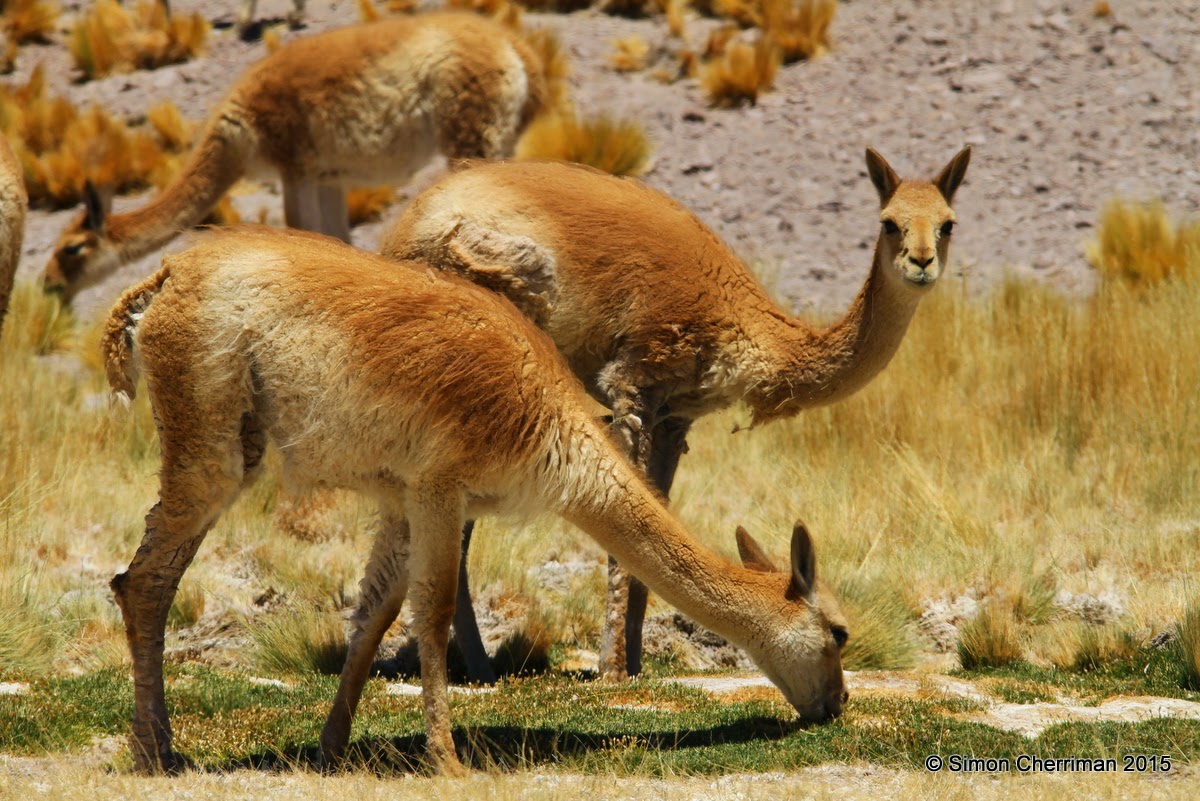
Like other vultures, condors are scavenging birds, feeding on the carcasses of dead animals which include the indiginous Guanaco (Lama guanicoe) a member of the camel family, pictured below), as well as introduced sheep and goats. Unlike eagles, they do not have the specialy adapted crushing ability in their feet, nor the large talons capable of inflicting a mortal wound to live prey. Delcines in the availability of their native prey has reduced the Andean Condor population significantly, and they are now listed as ´Near Threatened´, but the sheer expanse of the unique Andes Mountains has meant the species still has a stronghold. And nothing symbolises this vast mountain range more perfectly than the characteristic silhouette of this truly magical bird.

Tuesday, 10 February 2015

Pupuya


On the coast of Chile about 200 km from the frantic city life of Santiago lies a small holiday settlement. The dark sand dunes are punctuated with amazing forms of vegetation - cacti, small succulents and various grasses - which wait out the mostly dry conditions, only able to quench their thirst in the morning, when a thick mist of evaporated Pacific Ocean water descends on the coast. Waterbirds of many shapes and sizes congregate in the mouth of the small river which cuts through the sand dunes to the sea. Giant rock stacks just offshore dance with activity as breeding seabirds - pelicans, boobies, and cormorants - hurry back and forth from their hungry chicks to the vast ocean that is their larder. Black vultures circle overhead, scanning the breeding colonies and the beach and farmland below, hoping the next victim of nature´s harsh reality will provide them with another meal. Where is this place, you ask? It is not in a fairytale book, but a real and wonderful destination where I currently have the privilege of staying. A stunning beach town called Pupuya.


This town is a very quiet and largely unknown place, but in recent years its popularity among the surfing, wind-surfing and kite-surfing community has grown. This has created an accommodation demand for young people who are into these sports, as well as the occasional wandering Australian (not really into any sports) like me! The place where we are staying, Dunas de Pupuya, is a small hostel located only 10 minutes walk from the beach. When my friend Sofia told me a few weeks ago that we would be staying at a ´hostel´, a certain image formed in my mind, but this was nowhere near accurate enough to depict the real situation I would find myself in. Indeed, my mental image fell far short of this beautiful reality! Hostel Dunas de Pupuya is a classic beach-style building, made mostly from wood, and with an overriding rustic theme that for me created an instant feeling of homeliness. From the white-washed brick wall outside to the half-sanded aqua-blue table in the kitchen, and the wood-grained wall panels and irregular staircase which creaks as you follow it upstairs to your cosy bedroom, the raw nature of the hostel can be observed throughout.

Bienvenidos! Welcome to Hostel Dunas de Pupuya
As well as the numerous bunk rooms on both floors, there is a ping-pong table in the main entrance, an outdoor decked area complete with a fire pit (and a brilliant wall mural of a very topical kite-surfer), a cosy lounge with a TV and videos for those cold, ´indoor days´(not relevant on my current holiday!), and a couple of secretive hammocks for those desiring a quiet read or nap to recharge the batteries. One of these, in the front garden, is in a particularly pretty spot as the front wall is decorated with a stunning Fuscia plant, adorned with pink flowers that hang like pendant jewels. Being one of my Mum´s favourite garden plants, I always get a sense of nostalgia when I see them.

Some ´backpackers´enjoying the front garden, complete with Fuscias.
Plenty of room to relax in the ´backyard´and enjoy the sun.

Outside, narrow dirt roads and tracks connect the hostel to the main part of Pupuya, as well as a supermarket (only a 2 minute walk from the front door), and a few different routes to the beach. If you are like me and super keen to quickly immerse yourself in nature at the earliest possible opportunity, you can scramble down a lupin-clad embankment just 50m from the hostel and follow a small stream which eventually leads to the estuary. Although this waterway is far from pristine, and there are obvious signs of degradation from cattle crazing, plastic litter and other pollution, I quickly discovered that there is an amazing diversity of natural history to discover and observe. The noisy calls of ´Telquehue´(a local lapwing species which sounds the alarm at the first sign of an intruder) are the first thing to capture your attention, and many small songbirds including Diuca, Loica, Gorrion (a sparrow) and Tenca flitting about the open paddocks and perching atop blackberry bushes further bring the place to life. You might even notice a Tiuque, a local bird of prey in a family known as ´caracaras´ (not found in Australia), and a species which I have noticed regularly land on the ground and are not too worried about human presence, something most unusual for a raptor.


Further downstream the narrow waterway opens out into a wide estuary, and here a variety of shorebirds, including oystercatchers, curlew, terns, ducks, gulls and stilts, perch regularly on a large sandbar. These are the obvious species, but when you spend some time sitting quietly at the water´s edge, you might be very lucky to spy more secretive waterbirds dashing out from the cover of their reedy habitat - birds like the Gallineta (Blackish Rail, Pardirallus nigricans) and Taguita (Spot-flanked Gallinule, Gallinula melanops), which bring a tingle of excitement to any birdwatcher eager to encounter those species which rarely allow even the slightest glimpse of their unique beauty to the world. Considering the amount of grazing by cows that are allowed to roam around the river banks, I was pleasantly surprised to see even a small patch of natural riparian vegetation, let alone one big enough to support a several secretive reed-dwellers. It is these examples of nature ´clinging on despite the odds´ which I draw huge positive energy from, and feel the need to emphasise the importance of using such examples to tell as positive stories about the environment, when it comes to educating and inspiring others.

The Pupuya estuary is just back from the Chilean coast and is a popular spot for family holiday activities.
Just before you reach the main beach, the estuary comes to a dead end - in summer a large sandbar prevents the freshwater from flowing into the salt. This is great for Chileans on holiday as the estuary water, being much warmer and shallower than the ocean, makes a great spot for swimming and fun and games for the kids. Looking closely at the water I observed quite a bit of sediment, and having just observed the cows defecating straight into the water upstream, I did wonder about the potential health impacts of ´taking the plunge´. Perhaps there is an opportunity here for some research into the impacts of human activity on this system, and how the excess nutrients might affect both the wildlife and people who live here?

Beyond the sandbar lies the pounding ocean. On a fine blue day, like the above photo, it is a soft aqua in colour, and the white froth on the waves looks gentle and beckoning. But when the coastal mist I mentioned at the beginning (thickest in the early morning) hangs overhead, the sea adopts a very different appearance. It is cold, duller and angry, and the distant rock stacks just off the coast appear as abandoned castles. Even though they seem lifeless to the naked eye, however, when viewed through binoculars you can easily see they are far from deserted. The dozens of black dots wheeling above are actually (you guessed it!) more birds - pelicans, boobies and cormorants - each species making their nests on the bare rock, and enjoying the safety provided by the sheer number of birds that make up this breeding colony. I have visited a few seabird colonies in the past, but none with as much mystery as the rock off the coast of Pupuya.

A large rock stack off the coast of Pupuya houses thousands of breeding seabirds.

Brown Pelicans, Peruvian Boobies and the occasional Cormorant are visible on the ´block of flats´ rockface.

An adult Kelp Gull (Larus dominicanus) perches on a rock on the Chilean coast.

Juvenile Kelp Gulls are much duller than their parents but are equally as beautiful. 

For those more adventurous types, long beach walks both north and south of the river mouth make a nice day out. Whether the sky is blue or grey, there is always something to see, and experiencing this environment during different conditions only allows the visitor a greater appreciation of the variety of both wildlife and culture in this unique place. A favourite for me has been the incredible vegetation types covering the cliffs (I also mentioned these in my scene-setting opening). Gardens of cactus and succulents carpet the harsh rocky escarpments from top to bottom, and are definitely worth a closer look (just take care when lying on your belly to capture those low-angle shots – cactus spines can be quite unforgiving!). It is quite remarkable to think how plants really can survive in any condition, eking out a living in the most unliveable places.


When it´s time to walk back home (and trust me, you will feel at home when staying at Dunas de Pupuya), nothing beats continuing the ´loop´ walk you began earlier and scaling the taller dunes on the north side of the estuary. This bit of higher ground not only gives you a fabulous view of the beautiful coast and ocean, but there is one more very important stop to make. And this time, it doesn´t involve birds… but it does involve food! The Márola Restaurant is a relatively new addition to Pupuya, and before you even enter the door you already know it is going to be the best place to eat! I was amazed with the building´s fantastic design and brilliant vista - perfect at midday if you care to stop in for lunch and a coffee, and even better at any time throughout the afternoon for those people keen to indulge in a great variety of local specialties to bring a highlight to their holiday.The first lunch I enjoyed was a Sandwich Mediterraneo con pollo, queso de cabra, pimiento asado y pesto (a roasted chicken sandwich with goat´s cheese, capsicum, pesto and olives if you wish). This was one of the best meals I have ever had, especially as I chose to wash it down with a couple of gold Corona´s! But returning in the evening to have a hot meal and watch the sun set over the Pacific is really the way to get the full appreciation for the Marola Restaurant. The pink sky and pretty interior lighting create just the mood one needs for a relaxing evening, and if you are like me and can´t resist a dessert, I thoroughly recommend the Volcán de Chocolate con helado vainilla (chocolate cake and vanilla icecream - mmmmm!).

The Marola Restaurant´s large windows make you feel like you are outside on the beach!

Chocolate pudding with icecream is the perfect way to finish (or start!) and holiday!
I would like to thank Daniela y Julio, managers of the Hostel Dunas de Pupuya and the Marola Restaurant, for their wonderful hospitality, generosity with letting me use their laptop (so I could write this blog!), and fantastic Spanish lessons which have been most helpful to a wandering Aussie! More information about both places can be found at the website links given in this post. The Marola Restaurant is open from 12 noon until 11 pm every day except Tuesday. In case you want to tease your tastebuds before going, the menu can be viewed on the restaurant´s website.


Tuesday, 3 February 2015

Simmo en Chile


Being over 2 m tall has many advantages, but folding yourself up to sit in the time machine that is a commercial aircraft for more than 12 hours certainly isn´t one of them! After a long and arduous flight I finally arrived in Chile, a country I have long wanted to visit since meeting some wonderful people who became close friends of mine while studying in New Zealand 5 years ago, on Saturday. It was brilliant to be collected by my friend Jaime and be shown around Santiago for the first time. There are many things to write about, but for these blog posts I will focus on (surprise, surprise!), BIRDS!! I hope I will be able to add pictures of the different species I see as I go, and share with you some of the new discoveries I make while travelling.

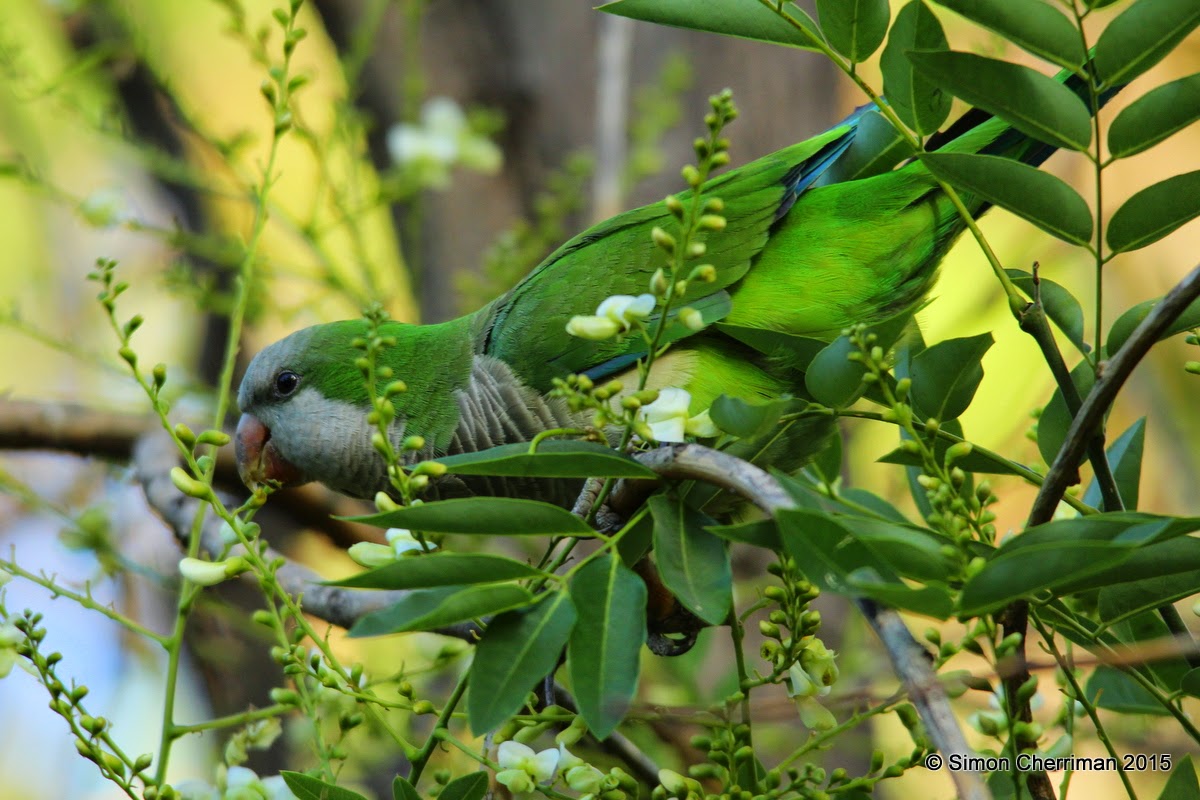
The first bird I laid eyes on was a pretty looking parrot, known locally as ´Corro Argentina´, or the Monk Parakeet (Myiopsitta monachus). This species is initally beautiful to observe, but when you learn they are an invasive bird responsible for the ousting of many endemic and now endangered species of Chilean parrot, their bright appearance loses its gloss quite considerably. I instantly thought how amazing it was to learn of an ecological equivalent to the feral Rainbow Lorikeet (Trichoglossus moluccanus) which is having a virtually identical impact to local native parrots in the south-west of Western Australia. Here are a couple of photos of the Corro Argentina that I took close to the centre of Santiago, where they can be observed easily.

Badness beneath beauty: Monk Parakeets have displaced native parrot species in Chile.


Let´s move on to a very common species which is much more widespead, and although also associated with negativity, this bird is generally pretty harmless to other speices. As you might expect, the most well known bird of the city is a Feral Pigeon, one of the most common and widespread birds in the world! Even though they are often described as ´rats of the sky´, they are still beautiful when viewed in the pretty sunlight.


One of the first birds whose Spanish name I learned is this fella, a ´Zorzal´.

The male (´macho´) Zorzal has a dark head which contrasts vividly with the yellow beak. The female (´hembra)´s head is pale.
If the bird pictured seems familiar, it is because it is basically the South American equivalent of a Blackbird, commonly observed in the United Kingdom, and eastern Australia and New Zealand, where they were introduced. Again, these species are very common and easy to approach and observe, but it is such birds that we often take for granted and I believe are well worth that second look. Watch this space for more new Chilean birds coming soon!

Saturday, 24 January 2015

Film Reviews - from the next generation


TEAR JERKING! I have just received the most wonderful piece of feedback from a close friend about the impact that my latest film, 'Where Do Eagles Dare?', has had on her 5 year-old son:

"You are inspiring the younger generation! He has watched your DVD twice and here he is building a hide so he can watch birds. Notice he is all dressed up in his camouflage gear!!!"

THIS is why I do what I do! It gives me an enormous drive to carry on my life's mission to receive this sort of feedback. THANKYOU to my friend who sent this to me, it makes all those hours spent in the edit suite, and all the effort of finishing a film, worth EVERY minute :D

Here is the little boy's completed hide. What a ripper! 


Thursday, 22 January 2015

CREEC Cockies


This photo is nothing out of the ordinary... but the bird in it is very special indeed. It is a male Kaarak (Forest Red-tailed Black Cockatoo, Calyptorhynchus banksii naso), one of three large and threatened cockatoo species found in south-west Western Australia. I took this photo while taking 10 wonderful children (plus a few super keen parents!) for a bird walk today at the brilliant Canning River Eco Education Centre (CREEC) in Cannington.

We all met bright and early at the centre and began the 'Home Among the Gum Trees' workshop, one of the school holiday activities coordinated by the Nearer to Nature Program. Our group was such a wonderful bunch of young, enthusiastic kids who were so efficient that we finished much earlier than expected, securing the final hinges into place on the last box not long after lunch time. This was obviously meant to happen, because we were later to make an EXCITING discovery!


Not far from the busy cafe and rumbling car park, a beautiful pair of Kaaraks were prospecting for a nest site. Being down by the Canning River (Djaalgarra) on a habitat work, exploring the plants and bird life of the area, we hadn't noticed at first, but as we looped past the picnic tables a grating sound caught my ears. It was the male cockatoo giving a breeding call, and we looked up to see him display flashes of his brilliant red tail at his mate, who was inspecting some large hollow branches in an introduced Sugar Gum. We watched with utter thrill as the pair visited about 3 different hollow spouts, the male 'guarding' his partner and watching on as she looked inside, and chewed around the hollow entrances. Soon it became apparent that the hollows were not deep enough, as the female could not get even half of her body inside. The pair continued prospecting though, and flew to look at the potential of several other trees in search of more hollows.

This behaviour is rarely recorded and as far as I know, there is still only one other site on the Swan Coastal Plain where this species breeds. Plans are underway to install a large cockatoo nest box at this site with the hope that it might encourage breeding. We'd like to say a big THANKS to Nearer to Nature who planned this workshop, the parents and volunteers who helped the day run smoothing, and most important, all the wonderful kids who attended, made some fantastic nest boxes to take home, and were an integral part of an exciting day! Here's a group photo of myself and Gill with a few of the kids who took part in the day.

Six of the 10 children with their completed nest boxes for small parrots.

Tuesday, 13 January 2015

Mundaring Shire Open Day


Last weekend the Mundaring Shire held an open day to mark the one year anniversary of the Parkerville/Stoneville/Mt Helena Bushfires. Part of this event included a small display to show a couple of my nest boxes, with the aim to attract attention from the local community (especially people who lost homes or backyards in the fires) and seek their interest in attending a nest box building workshop that the Shire is planning to hold at the Mundaring Men's Shed later in 2015. This will involve us building boxes with locals for them to take home and install at their burnt (but swiftly recovering) properties to improve the biodiversity values. Many properties that were singed by the flames lost large, hollow-bearing trees, either directly in the fire, or afterwards when such trees were pushed over to improve safety to residents. These trees are vitally important for native wildlife (like the possums and parrots shown in the photos below) and cannot be replaced for hundreds of years. Nest boxes will help to provide habitat for local wildlife, hopefully enthuse local residents about some of the other creatures that were affected, and reinforce that they can think positively and recover from natural disasters like bushfires.

If you require more information about my nest boxes (and if you wish to order one for your backyard), please visit this page. Nest box workshops are run as part of the Re-Cyc-Oloy Project and you can find more information about this here.


Sunday, 11 January 2015

Installing Cockatoo Boxes


Today I was lucky to visit a beautiful bush block in Mundaring and install 2 nest boxes. It was extremely special because the owner of the block used to do fitness class with me many years ago when I was in high school, and we have bumped into each other many times in the local community since. Susan also works as a teacher at Parkerville Primary School, and we did a talk to her class as part of a nest box workshop conducted back in 2012.

Both nest boxes were large sizes designed for Black Cockatoos. Susan has resident Forest Red-tails in her area often, so is hoping to encourage breeding of this threatened species. Thee odds are good, as we know this design has worked for other black cockatoo species before, including Carnaby's Cockatoos in the Porongurups. We also had a pair of Red-tails lay an egg inside one of my nest boxes installed on another hills bush block in 2012 (the egg was subsequently abandoned, we think because Galahs drove the birds away). You can read more about that story here.

Here are a couple more photos of the boxes going up. Thanks to Susan for taking the pictures and allowing me to use them here :)

You can see how chain is used to hold the box up, and it is threaded through recycled hosepipe to protect the tree's bark.

This Jarrah tree is at least 100 years old but has only tiny natural hollows.

Monday, 5 January 2015

Striking Gold in Sydney


There once existed a myth about a mysterious city made of gold, El Dorado, located somewhere in the remote Amazon of South America. The thought of discovering endless riches drove Spanish conquistadores in the 16th century on countless gripping adventures. Gold fever has since motivated many people to search for this gleaming substance, often resulting in greed, anger and death. But there are other golden things in our world - living creatures, tiny wondrous organisms perfectly crafted by evolution - which, although not worth much in monetary value, can provide just as much mystery, plenty of mental stimulation and far more satisfaction than a pice of lifeless metal. Today in Sydney I found three of them.


An ordinary street scene, in the middle of which you can see an ordinary sign post. No, it's not made of gold! But when I looked closely I could make out a beautiful eight-legged creature who makes her living from spinning with gold silk.


This is a Sydney Golden Orb Spider (Nephila plumipes). Orb Weavers are a widespread and conspicuous Australian species, something that doesn't necessarily do them much good - being a spider and standing out might lead to you getting swatted by a fearful Australian human! However, unless you happen to be a small, flying insect, there is no reason to be worried about these creatures at all. They aren't poisonous and spend virtually all their time hanging in their wonderful webs, and even if one plasters across your face as you accidentally walk into it, the spider will quickly drop down and run for cover. Golden Orbs take their name from the colour of their silk. Even on cloudy days the web has an eye-catching lustre. It is often this which has alerted me to golden orbs' presence, together with the chain of food morsels which can easily be seen hanging from the web. The large spiders you can see are the females - males are much smaller and can sometimes be found clinging to leaves and stems of plants to which the female's web is attached.


When I zoomed out a bit and headed down the garden path to the block of flats I'm staying in, I was delighted to notice a well-kept garden bed with a little sea of mostly native ground-covers growing on a bed of fresh wood-chips. There were purple Scaevolas but more eye-catching were the tiny pom-pom heads of yellow poker flowers. Their golden glow is spectacular in the midday sun, and I soon saw that I wasn't the only one attracted to the colours. A tiny native bee honed in on the purple blooms, and a small fly (Drosophila?) was going for gold. Through a macro lens I observed the incredible fine detail of its body: coarse hairs stuck out from its thorax which glowed a solid gold like some type of giant treasure in an Egyptian's tomb.


Other golden jewels were visible on an even finer level. Grains of pollen were glued to the fly's body hair and the tips of its feet, the precise reason why the plant has concocted a sweet nectar for the fly to drink, and attracted it with a vivid golden sign which says 'Free: Sweet Drink'! When it ventures to the next sugar-meal, the fly will unsuspectingly do the plant a favour and transfer pollen grains, allowing the plant to reproduce.

So what is the third creature I found? It is another microscopic insect which is invisible to the naked eye. If I hadn't zoomed it to snap the fly with a macro lens I wouldn't have seen it. But its tiny body moved as it also sought nectar from the yellow flower, the movement catching my eye. I'm not even sure what it is - a tiny beetle perhaps? You can just make it out in this photo, another small animal as golden as the web of the Orb Spider.


All that glitters is not gold. Indeed, it can sometimes be something much more exciting! And all in a small patch of greenery inside a busy city suburb.