Welcome to the News section of the iNSiGHT Ornithology website (https://www.simoncherriman.com.au/). This blog contains updates about various things I've been up to, interesting environmental issues and observations I make regularly while going about my day. It is designed to be fun AND educational, and inspire you about our wonderful natural world. Happy reading!

Thursday, 12 November 2015

Morning Kaaraks


This morning I woke to the sound of a young Kaarak (Forest Red-tailed Black Cockatoo) calling outside my window. I was half asleep, but the closeness of the characteristic soft wheezing drew me further out of my slumber and urged me to go and investigate. Camera in hand, I ventured outside and saw a juvenile cockatoo perched quite low in a Marri tree just near the house, its parents foraging on 'honkey nuts' just above its head. Normally family groups of this species which visit my bush garden are quite wary and not particularly tolerant of a photographer stalking them! On this occasion, however, this family trio didn't' seem worried, and from my verandah I managed to sneak closer and snap away just as the female descended to her beautiful baby and gave her some breakfast.

An adult female Kaarak feeds her offspring some 'Marri muesli' for breakfast.

Despite a few mouthfuls of 'marri muesli', the young Kaarak still wasn't happy, and she kept wheezing and climbed higher towards her father. Young cockatoos spend several years with their parents, learning the art of foraging, and also gaining practice at navigating their way around the canopy. Even if they aren't giving the unmistakable contact call of a juvenile, observing their climbing method can be a dead giveaway to their age. This young one took a little negotiating to make her way around a clump of new foliage growing out of the Marri limb on which she was clambering - a funny sight! Eventually she reached 'dad' and was given a second helping.


Knowing the cockatoos were outside enjoying the natural habitat this bush block provides was a wonderful feeling, and a brilliant way to start the day. Now time for my breakfast!

The female Kaarak (left) with her offspring, who is busy nibbling her perch!

Wednesday, 4 November 2015

Colour-ringing Wedgies


Setting off towards a speck in the distance that is a giant Wedge-tailed Eagle nest always evokes a feeling of excitement, especially when you have visited it two months prior and know the chick you saw then will now be fully-grown and nearly ready to fly. With my mum and sister leading the way, I began the descent into the rugged Perth Hills valley, clutching the straps of my backpack to ease the load of heavy climbing gear, ropes, cameras, lenses and eagle-banding equipment on my shoulders.
 

An hour later, the three of us stopped in the shade of the Wandoo nest tree, which was now quite a bit taller than when I first climbed this particular eagle nest 16 years ago. The nest, too, had increased substantially in size, being more than 2 m deep and just as wide, making me look like a midget as I ascended my rope to just below the nest, and peered over the edge. I was delighted to see not one but two eagle chicks, an indicator that food supply in this territory had been ample this season, and that the adult eagles were probably experienced breeders. It was an extra special feeling after making a similar discovery at Matuwa (Lorna Glen) just a few weeks prior – 2015 must be a lucky year for ‘twins’!).
  
Before: The two eaglets aged about 1 week in early September. One chick normally dies in the first few weeks on the nest.
After: The same two eaglets, now large juveniles, 10 weeks later. One is very well camouflaged among the nest cavity.
I managed to capture both juvenile eagles - one female (left) and the other a male (right) - and lower them to the ground in a handling bag, before they were ready for processing.

As part of a long-term study on Wedge-tailed Eagle ecology in the Perth region, I have this year obtained the relevant State and Federal licenses to commence marking individual fledgling (juvenile) eagles with leg-rings (bands). A stainless steel ring from the Australian Bird and Bat Banding Scheme (ABBBS) is placed on the right leg, and a yellow colour-ring (custom made by IO Mekaniska in Sweden) with a 3-digit number is placed on the birds’ left leg. The only other colour rings being used on Wedge-tailed Eagles in Australia are the blue ones at Matuwa in the WA Arid Zone, where I have also been researching wedge-tail movements. The idea is that the colour-rings are highly visible and will allow any marked eagles, if they are re-sighted in the future, to be identified as a juvenile from one of the two study areas: Perth (yellow) or Matuwa (blue). If the number can be read, we can then tell exactly which nest site the eagle came from. And yes, you are right: I have chosen these two colours to match those of the Aussie Rules football team whose mascot is the majestic eagle from the West Coast ;-)

The yellow colour rings are unique to the Perth Region study area and are designed to be easily visible.
While mum held onto one eagle, my sister and I recorded measurements from the other, then we swapped over. Apart from standard morphometrics like weight, wing length, tarsal (lower leg) length and head-bill length, another measurement being taken is the length of the rear talon, and it was amazing to record the female eagle had a rear talon of just over 40mm, quite a weapon! Imagine being a small animal on the receiving end of that one day!


When both eagles had been ringed and processed, I ascended my ropes again to return them to their nest. With such well-developed wings, one has to be careful that eagles do not 'fledge early' and fly from their nest in an escape manoeuvre prompted by a person releasing them. My trick is to hang from my climbing rope just below the rim of the eagle nest, remove each bird, one at a time, from the handling bag, then release them upwards onto their nest. I find as soon as the birds' wings are out, they hold them up and flap slightly, and when their legs are released, the birds basically flap themselves back onto the eyrie. By hanging below the nest one is effectively out of sight, and not causing the looming threat that a person would if they were hanging level with or above the nest and towering over the eaglets.

It was wonderful to look back across the valley and see both juvenile eagles standing on their eyrie, exercising their very well-developed wings and peering out across the valley, and probably watching my every footstep, just as they had been earlier in the afternoon. The adult birds, highly alert to every movement in the vicinity of their nest site, were also watching with piercing eyes as three small specks of human ascended the opposite hill and climbed into their car. What an exciting afternoon - for all seven of us.


Sunday, 1 November 2015

Kite Family


It is that time of year when I visit a certain gully in the Perth hills to check the breeding progress of the family of Square-tailed Kites I've been monitoring for the past few years. This species, known as Mararl or Djedurnmalak in the Noongar language, is one of my favourite raptors, so I was very excited to reach the nest and find a female kite sitting, a good sign it was active again! When I ascended the nest tree, I found the female had something to be very proud of...


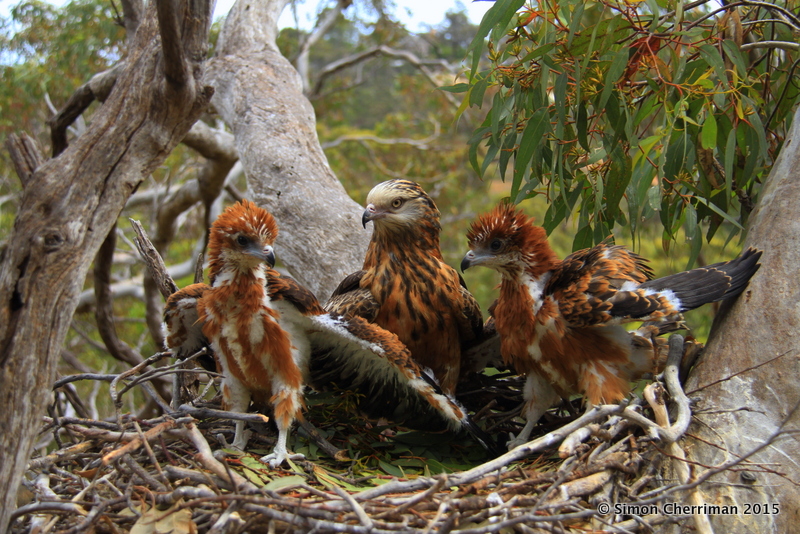
The first thing that went through my mind was the voice of my good friend Ewan, a raptor biologist from Scotland, saying "It's a Red Kite chick you little bloody ripper!!" (This came from our visit to the nest of a Red Kite, a species very similar to the Australian Square-tailed Kite but one in a different genus, during my time in Scotland last year). The second thing I thought was - "W-O-W!!". These two exceptionally beautiful and well-grown kite chicks are about a month old, their wing feathers well emerged and body feathers gradually covering up their natal down. It will take about a three more weeks before they are ready to fledge.

The younger kite chick has slightly more natal down still showing.


The older kite chick with its very flash 'mohawk'!

As I was about to leave the tree, the female kite's behaviour changed, as though she seemed to want to tell me something. I sat for a few more minutes, and the goosebumps spread across me as she walked to the edge of the nest, flapped towards me and landed on a perch less than a metre away! She then proceeded to perch and look at me, as gentle and placid as ever, as though jogging her memories of previous time we've spent in the canopy together, and scan around the bush, perhaps in anticipation of her mate returning with food.


It was wonderful to find the kites have nested again, and that everything is on track for successful fledging. They still remain one of my most favourite birds.


Tuesday, 13 October 2015

Quenda in the Media


I'm always keen to help educate others about our unique flora and fauna, especially through wildlife photography, which has been a passion of mine for some time now. Several years ago I donated a few pictures (mostly of the Baudin's Cockatoo and the Quenda or Southern Brown Bandicoot) to the World Wildlife Fund (WWF) Australia, to use in any media pertaining to these two beautiful native animals. Recently these images have been used in some online articles about the Quenda, which, despite being listened as a priority fauna species in south-west Western Australia, has been increasing in abundance in some parts of its range. Its capability to adapt to and take advantage of habitat in urban areas and backyards which is not necessarily composed of native vegetation seems to have allowed it to do well. Right here in the Mundaring Shire where I've spent most of my life, there has been a noticeable increase in Quenda sightings in the past 20 years, both of live animals and  road-killed ones, which, despite being a sad sight, are often an indicator of abundance. Check out this article in The Guardian and another one on WWF's website to see the images and read more about how you can get involved in the 'Quenda Count, an initiative to gather important information on these wonderful native marsupials!

Tuesday, 22 September 2015

Breaking News


The chew-marks on the sacrificial hardwood planks around the rim of the nest box were suspicious, but after whacking the base of the tree-trunk several times in the hope to rouse any occupants, it seemed to be empty. Eager to gain a look inside for more clues, I began pulling a climbing rope over a sturdy fork in the beautiful Marri tree in which the large nest box hung. Suddenly, as the rope neared the box, I heard claws grapple the metal ladder inside, glanced upward, and in a black-grey blur, glimpsed a bird's wing and head poke upwards. The bird paused just long enough for me to focus on an off-white cheek patch, then burst forwards and spread its wings, the glorious white panels on the fanned-out tail catching the morning sun. A CARNABY'S COCKATOO!

Today I had the privilege of spending the day in Parkerville and Stoneville with a team of Friends Groups and Mundaring Shire staff, inspecting nest boxes that I installed in burnt reserves earlier this year. Overall we found a high occupancy rate with 19 of the 34 boxes checked (56%) being occupied or showed signs of being used this year. Two boxes had been vandalised so were taken for repair/replacement. There were mixed results with the occupancy of different designed boxes - none of the bat or pardalote boxes were occupied, probably owing to the fact these species require smaller hollows and have many alternative breeding/roosting sites. Eight boxes had clutches of Australian Ringneck Parrots (Barnadius zonarius) inside, three had Galahs (Eolophus roseicapillus), and several others had evidence of Brushtail Possums (Trichosurus vulpecula) denning inside, although we didn't see any possums on the day. Keeping in mind that checking one box on one day doesn't mean it has never been used - the tenants may have simply been sleeping elsewhere! It was so pleasing to see local wildlife clearly benefiting from these artificial hollows... and for one species, the benefit is just the sort of thing it needs to perhaps save it from extinction...

I cannot find words for the feeling inside me when I watched the beautiful and magic Carnaby's Cockatoo (known as 'Ngolyenok' in the Noongar language) emerge from the cockatoo box! This species normally breeds much further inland in Wandoo Woodland of the Wheatbelt region, and although there is a recent increase in breeding records closer to the Swan Coastal Plain (thought to be due to habitat loss and a drying climate), I didn't imagine finding a nest box that was only installed a few months ago to be so quickly occupied by a bird that has previously only used artificial hollows placed within 1km of existing nests!

A quick tree-climb revealed she was sitting on a clutch of 2 eggs, laid on the bed of woodchips my friend Emily had so diligently collected on the day of installation. I can't reveal too much more at this stage... but I will be back to follow up on this story with great enthusiasm!

Sunday, 23 August 2015

Djeran Jarrah Wildflowers


Western Australia's 'wildflower region' is normally described as being the inland area north-east of Perth, known as the Mid West. Many families plan holiday trips to see the wildflowers, which is a wonderful thing to do and the carpets of pinks, whites and yellows are truly breathtaking. But often this focus on one particular part of the state takes attention away from patches of bush right here in the Perth Hills with just as much wildflower diversity.

Lately I've been noticing the various local understorey plants come into bloom. In the Jarrah forest at the moment you can see carpets of the pea flower Bossaiea pulchella, commonly known as 'Bacon-and-Eggs'. These gorgeous yellow decorations bring the forest floor to life, and have beautifully detailed petals when viewed up close.

The colours of pea flowers like this Bossiaea give rise to the common name 'Bacon-and-Eggs'

Another pea flower, but one whose owner makes a living creeping over shrubs and climbing up trees (what a great way to live!), is the Native Wisteria (Hardenbergia comptoniana). This plant really becomes visible when its vivid purple blossoms burst open. It is often surprising to spot them high up in the canopy and suddenly notice the vine's stem winding its way down tree-trunks and through foliage back to its source on the ground.


An even smaller plant but one whose cream-coloured and very delicate blooms (about 2 cm long) stand out amongst the leafy forest floor is the Catkin Grevillea (Grevillea synapheae). The 'flower' one sees is actually a collection of flowers (an 'inflorescence') which grow in an arrangement known as a 'raceme' - a long cluster with separate flowers attached by short stalks.

Catkin Grevillea flowers have beautiful detail when viewed under macro.

Having a sharp macro lens allows one to photograph then observe features otherwise invisible to the human eye, like the grevillea petals shown above. If you spend enough time with such a lens, you begin to look for photography subjects that you know will reveal hidden details once enlarged. With this in mind, I decided to snap some pictures of a tiny Sundew (Drosera sp., probably D. stolonifera) with a very pretty leaf arrangement (below left). The beautiful sticky beads of mucilage (a sticky, sugary substance), which are used to capture insects that cater for the plants' nitrogen requirements, are clearly visible. I also noticed a Clustered Heath (Leucopogon capitellatus) plant, a species which has minute flowers (below right). When enlarged, the flower's tiny bearded petals are visible, and the genus name Leucopogon then makes sense: it comes from two Greek words: leucos = white; pogon = bearded. Click these images to see the details even more clearly.


When walking on gravelly ground in more open parts of the forest, it's hard to miss the stunning arrangements of conspicuous yellow flowers in the genus Hibbertia, known as buttercups. The most common species is the Yellow Buttercup (H. hypericoides), whose flowers are arranged in beautiful, dense layers across the shrub. 

Yellow Buttercup is one of the most common wildflowers in the bushland near Mundaring.

The aptly (some might say state-the-bl**dy-obviously!!) named Large Buttercup (H. lasiopus) has fewer flowers but compensates with the sheer size of its blooms. This plant has a very prostrate growth habit, and its scientific name is derived from it having a hairy seed pod (lasio = hairy; pus = foot).


All these species were observed in just a 15 minute walk around a local Mundaring Shire bush reserve. You can view more photos of local Jarrah and Marri forest wildflowers on my Flickr Photostream here. As the weather warms and we head into Kambarang (spring) over the coming months, keep your eyes out in your local patch of bushland. What flowers do you have blooming near you?

Saturday, 8 August 2015

Wetlands: Wonder and Wildlife

Wetlands are VITAL... in so many ways.

Today's issue of the West Australian's Ed! Magazine featured a double page spread I wrote on the importance of our unique, local wetlands here in Perth. The article tells a story, which begins like this...

Long ago in the dreaming, a giant serpent, the Wagyl, slithered across the land, twisting across the surface on a magical journey. It moved over the south-west of Western Australia, pushing up the ground to form mountains, and carving great channels into the earth. These soon filled with water and created the many rivers, lakes and swamps that the Noongar people, traditional custodians of this ancient land of the south-west, became familiar with. As the Noongar culture continues its 40 000 year journey and lives on in modern times, the wetlands continue to hold special cultural significance for those people strongly bonded to the earth.

Pacific Black Duck (Anas superciliosa), known as 'Yet' in Noongar, is still a very common waterbird seen that can be seen on many of Perth's wetlands.

Unfortunately the European explorers, who  in 1697 would paddle a longboat up the greatest of these wetlands, Derbal Yerrigan (later dubbed the Swan River), and the subsequent settlers who arrived in the early 1800s, did not value the Perth regions' wetlands as strongly. Their attitude of controlling and conquering nature soon lead to about 80% of wetlands on the Swan Coastal Plain being drained, flattened and turned into rubbish tips. It is only in relatively recent decades that our modern society has come to learn what the Noongar people had known all along: wetland ecosystems are a vital source of life-giving water, provide habitat for a diverse range of wildlife, and perform important environmental jobs which cleanse the air and water. In this way they directly benefit all living things which reside on this land today, including humans.
But what are wetlands? Which types of animals and plants call them home? And what can we do to ensure those we have left are conserved for the future? Come with me on a journey of discovery to find out!


What is a Wetland?
The term wetland is used to describe any ecosystem which is covered with water at any time during the year. Wetlands can be either freshwater, saltwater or a mix of both. Here we will focus mostly on freshwater wetlands of the Perth region, which include lakes, swamps, rivers and creeks. 

The Swan – Perth’s Iconic River
From the air, Derbal Yerrigan is the most prominent wetland in Perth. It drains water from the Darling Range (Perth Hills) and further inland west towards the ocean. A large rock bar once permanently blocked the river mouth (where Fremantle is today), limiting seawater from coming upstream and keeping this giant estuary fresh water. When the Fremantle Harbour was constructed in the 1890s, the rock bar was blown up and now much of the river is part saltwater. But the Swan River still supports a huge range of wildlife, particularly waterbirds, including the Black Swan (‘marli’ or ‘koltjak’ in Noongar), which nests along the banks, and many ducks, terns and cormorants. Below the surface, fish like Black Bream and Flathead are common and a popular target for keen fishers. And if you are super lucky, you might even observe some of the resident Bottlenose Dolphins which call our river home. At Bull Creek, a tributary of the Swan River Estuary which flows into the Canning River, freshwater crayfish known as Gilgies can still be found. These have declined in parts of their range, sometimes because of invasive ‘Yabbies’ (introduced from over east) which take over their habitat. Flooded Gums and Swamp Sheoaks, so named because of their water-loving habitats, represent the river’s original trees and today they provide shade at grassy picnic sites along the riverbank. 

Freshwater Chains
Large chains of freshwater lakes and swamps stretch parallel to the coast, both north and south of the Swan River. The two main ones are the Perth Great Lakes and the Beeliar chain. They have formed over thousands of years by water courses flowing west from the hills, which are slow-moving and become obstructed by one of the three Coastal Plain sand dune systems (Bassendean, Spearwood and Quindilup), so have had to divert their courses north or south. Eventually the flow of water moves underground, leaving a scattering of wet areas across the land’s surface, distinguishable by their different vegetation. Some of the plants found here include:

  • Modong/Moonah (Paperbark, Melaleuca preissiana) – large trees often growing in damp areas with underground freshwater. They provide shade and habitat for many small birds and frogs.
  • Yandjet (Bulrush, Typha species) – tall rushes that grow in dense clumps at the edge of larger lakes. Place names like Yanchep and Yangebup are derived from the Noongar word for this plant.

Swamp Paperbark (Melaleuca rhaphiophylla) thrives in fresh water.


Wetland chains have seen the most impact with urban development of the Perth region, and most lakes and swamps have been filled, drained and concreted. Two of the larger wetlands in the once extensive chain north of the river (close to Perth’s city centre) remain: Herdsman Lake and Lake Monger. Both sites provide important habitat for rarer birds like the Crested Grebe and occasionally Freckled Ducks, and contain high numbers of Oblong Turtles (Booyi in Noongar) which are nocturnal hunters of small fish and a range of macro-invertebrates (small animals living in the water). Swamp Harriers rear chicks on their flat, hidden nests among the Bulrush thickets, at Herdsman.
The bigger lakes contain water all year, but smaller swamps and creeks may only fill with water after rain. Some species of frog (like the very camouflaged Squelching Froglet) need sufficient winter rainfall to breed. Their activities are prompted by the first rains, which set the waterways flowing and send the frogs into a very loud chorus, an impressive sound considering they are only 2cm long! Digging into the moist earth to feed on frogs, as well as other tasty treats like earthworms and beetle larvae, is the Quenda or Southern Brown Bandicoot. This marsupial is one of the few remaining native mammals clinging on near Perth, and dense vegetation preserved in Regional Parks gives it suitable habitat.

A Quenda or Southern Brown Bandicoot (Isoodon obesulus) - one of the few native marsupials which still lives in Perth.

Beautiful Beeliar
The Beeliar chain, named after the Noongar word for the area, is found south of Fremantle and includes Bibra, Thomson’s and Forrestdale Lakes. Some of these sites are listed as Wetlands of International Importance (known as RAMSAR wetlands) because they provide important resources for migratory waterbirds.
  • Birds like the Red Knot (pictured below) travel thousands of kilometres from breeding grounds in the northern hemisphere to fatten up on the rich food source of worms found on muddy wetland edges.
  • Large colonies of White and Straw-necked Ibis build their nests in the lower paperbark shrubs each spring. These breeding sites can have hundreds of chicks and are a hive of activity!

All wetland chains were highly important for Noongar people who used them for ceremonies, and relied on them as sources of fresh water and places for hunting. Animals like waterfowl (ducks and swans) were hunted in summer when many species move to coastal wetlands to moult their flight feathers, making them easy to catch. Chains of wetlands were also important as trade routes between different tribes moving up and down the Swan Coastal Plain.

Red Knot (Calidris canutus) are migratory waders that travel from Australia to Siberia to breed.
 
Keep Wetlands Clean
Collecting litter is a regular activity when I visit Perth’s wetlands. I feel it vitally important to take away rubbish and help clean the environment, both for the creatures who live there, and other people who want to enjoy it. On one walk south of Perth I picked up an aluminium can which rattled. My curiosity had me cutting the can open when I got home and finding inside, to my horror, the head of a Tiger Snake! This poor creature’s scaly neck had got stuck in the can opening while trying to get inside, leading to its death.
On another visit I collected enough plastic bottles, cans, bike tyres and other plastic waste to fill my small kayak. I even pulled in two illegally set Gilgie nets which are often known to kill (by drowning) Oblong Turtles. 

Nurturing our wetlands by removing polluting items that affect their health has been a practice people of the Perth region have felt important for thousands of years. You wouldn’t leave a dead rat in your drink bottle, would you!? Removing litter items, or reporting those people who illegally discard waste, is a great way to contribute to a healthy wetland environment, and ultimately, a healthy you!

'Booyi' is the Noongar word for the Oblong Turtle (Chelodina oblonga).


 How can YOU experience wetlands?
Many of the large remaining wetlands have been set aside as natural reserves for the protection of plants, animals and water. These are places where fantastic trails and boardwalks often allow you to meander among the shady paperbarks and experience the beauty of our freshwater lakes and swamps, learning about them while doing so. A simple walk on a sunny afternoon at Herdsman Lake, Yangebup or along the upper reaches of the Canning River will almost certainly guarantee a sighting of a native waterbird. Experiencing nature through wetland walks, runs or rides is good for your fitness, and keeps your mind refreshed and healthy.

Hobbies that you might like to adopt that can take you on a journey exploring the wetlands in Perth, and beyond, include:

  • Birdwatching
  • Cycling
  • Painting or Drawing
  • Nature Walks
  • Wildflower Photography
  • Canoeing or Kayaking

Sometimes its nice to start with a guided tour and fortunately there are some brilliant environmental education centres to help you and your school. The Herdsman Lake Wildlife Centre runs educational activities . More information can be found at http://www.wagouldleague.com.au/.

If you are south of the river, a visit to the CREEC (Canning River Eco Education Centre) is a must! The entrance is adorned with beautiful paintings, photos and videos of wetlands and wildlife, examples of birds nests, and a ‘touch try’ where you can get up close to some wetland show-and-tell. Contact CREEC at creec@canning.wa.gov.au or on 9461 7160 for more information.

Friday, 3 July 2015

Grub's Up!


Carnaby's Black Cockatoo (Calyptorhynchus latirostris), or Gnolyenawk as it is known in the Noongar language, is well known for its ability to crack open the hard, woody fruits of native south-west Australian plants to extract the nutritious seeds inside. It forages at all levels of the canopy, hanging pendulously from drooping Marri (Corymbina calophylla) branches to clip off large 'honkey nut' fruits, and flapping down to almost ground level to sit atop low, spikey Hakea shrubs and prune their woody fruits. You can see a video showing some of this behaviour at the Agora Bushwalk website here. Less-known, however, is the fact that Carnaby's (as well as the closely related Baudin's Cockatoo, C. baudinii) love to feed on insects too. When a family trio of these majestic cockatoos snuck into my backyard to search for some 'grub' recently, I crept beneath them to observe their behaviour.

As you can see in the above photograph, this young female appears to be chewing the wood from the extremeties of the Marri tree she is sitting in. I've often heard people assume it must be to 'sharpen the birds' beak', or because they are destructive. But cockatoos are highly intelligent birds, and as I saw after watching the adult pair and their single offspring for some time, the expressions on their faces, and the way they cocked their head to look carefully beneath every piece of bark that they prized off the branch, told me the these birds knew exaxtly what they were after.

A tiny, white wood-boring beetle larvae is visble in this cockatoo's beak.

The soft timber of Marri is particularly attractive to wood-boring beetles, which lay their eggs on the surface. The larve of these creatures bore into the limbs and create small tunnels as they go, packing the cavity behind them with 'frass', the term used to describe the digested sawdust. The Cockatoos know this, and work their way along the limb, exposing the beetle larvae galleries as they go, and every so often, discover a fat, juicy grub. Using their finger-linke tongue in the same way they do to delicately remove seeds from fruit, the cockatoos pin the grub to their upper mandible, pick it out of its wooden home and swallow it whole, sometimes giving a brief chew on the way to the back of the throat. Such insect 'prey' makes for a highly nutritious meal, rich in protein, a relatively easy reward for a few minutes spent doing some woodwork.

It was beautiful to watch the natural behaviour of these birds getting their evening's nibbles in my own backyard - made possible by the retention of a few locally native gum trees, and a little patience. Next time you find strips of bark on the floor below a Marri tree, you might be able to picture who is responsible for dropping it, and what they've been up to.

A male Carnab'ys Cockatoo, identifiable from his pink eye-ring, in search of grubs beneath Marri bark.

While we are on the topic of using evidence to find out 'who's been around', you might wonder which type of bird leaves multiple, tiny 'u-shaped' marks around the rim of a Marri fruit? The culprit is another relatively frequent visitor to my backyard and possibly my favourite bird, Djarrailboordang, or the Red-capped Parrot (Purpureicephalus spurius). The other day I was very fortunate to capture a red-cap in the act of 'sipping seeds from a gumnut goblet', and show just how the beak leaves the marks one finds on a honkey nut. Like the Baudin's Cockatoo, red-caps have a very long upper mandible, used to probe into the fruit and hook out the seeds. The parrot, though, has a much smaller bill than the cockatoo, and the marks left by its lower mandible are high up around the rim, not low under the base, as with Baudin's. Using this evidence, you can easily determine which species has been feeding in your backyard, making hopefully more than just a small impression.