Welcome to the News section of the iNSiGHT Ornithology website (https://www.simoncherriman.com.au/). This blog contains updates about various things I've been up to, interesting environmental issues and observations I make regularly while going about my day. It is designed to be fun AND educational, and inspire you about our wonderful natural world. Happy reading!

Monday, 9 June 2014

The Golden Eyrie


This is a Golden Eagle (Aquila chrysaetos) chick - isn't it amazing!? It is virtually identical to a Wedge-tailed Eagle (A. audax) chick, and this makes sense given the very close relationship between the two species. Here are some stories about my adventures getting to know these young raptors over the past week...
 

Looking up from deep in a valley to this Golden Eagle eyrie, you can just make out the shape of a female tending her chicks. Her tawny nape feathers, a characteristic feature which gives the species its name, contrast with her darker breast which can just be seen against the bark of this wonderful Scots Pine. I never thought I would get to see an adult 'goldie' at an eyrie as eagles usually flush well before you see them, so being able to spot her briefly from a distance and watch the bird step off and glide away was a spine-tingling experience.


A tough hike up the slope, which prompted my calf muscles to remind me of their presence with every step, followed by a hand-scraping scramble into the canopy of a Scots Pine, gave me this view:

An adult Mountain Hare carcass - or what is left of one - with the two eaglets.

This beautiful brood of twins greeted us on the nest as I climbed to ring them with Ewan Weston, a Scottish ornithologist who has just completed his PhD on the species. Ewan, his partner Jenny Lennon, Stuart Rae and his brother Robert have been conducting various licensed bird ringing projects in north-east Scotland, and I've been tagging along over the last month to gain wider experience in handling and marking a variety of birds, especially raptors.

Eagles are ringed with a standard metal ring (complete with overlocking clasp to avoid a powerful bill from removing it!), issued by the British Trust for Ornithology (BTO). This is placed on the right leg, and Ewan has been using an additional aluminium coloured ring with a unique identification number for hopeful resighting in the field, placed on the left leg and secured with rivets. This method of marking is harmless to the birds and has been tried and tested over many years. Such monitoring is necessary to gain information on the movements and survival of young recruits to the Golden Eagle population which is still heavily persecuted by gamekeepers.

An aluminium ring is riveted in place on the eaglet's left leg.

At two other nests we visited, it was very pleasing to find broods of two on both nests, a good indicator that prey across these Golden Eagles' territories is in good supply. At one nest, which was well-hidden amongst Scots Pine foliage and took some finding earlier this year, the chicks were placed in a bag and lowered to be ringed on the ground.

Ewan Weston gently places the 5-week old eaglets in a bag to be lowered down.

Jenny guided me through the process and discussed the different measurements which are taken, including wing length, bill, hind talon length and halux (the length of an eagle's foot span, from toe to toe). Here you can see how well-developed the toes and talons are, even on a half-grown chick, and get a gauge for their size compared to human hands. The sheer size of these feet indicate it is a female, the much larger sex.

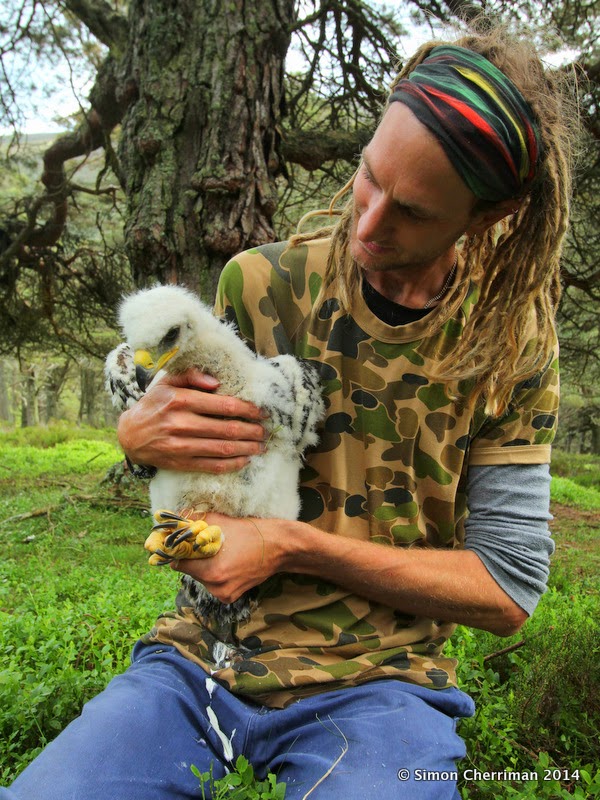
When the chicks were ready to be returned to their nest, I picked up one of them to place it in the hoisting bag, stopping briefly for a quick photo. The eaglet seemed to know it was on camera and had a sudden bout of nerves - leaving me with a very white wet-patch that soaked through three layers of clothing and (according to the old wives tale) left me with plenty of good luck! This 'goodbye gift' ensured the experience was certainly something I will never forget and I felt privileged to have been defecated on by such a wonderful bird!

The good luck certainly held true a couple of days later when we found the third brood of two sat in perhaps one of the most spectacularly placed eagle eyries I have ever seen, a mass of branches stacked heavily in the giant fork of an ancient Scots Pine. It was a hike and a half to reach this eyrie, but my effort of getting to the nest was quickly rewarded by an amazing sight. The bodies of not less than 13 prey animals were piled up at one edge of the eyrie, and at the opposite edge lay the eaglets, slightly damp from a brief morning shower. I have never experienced an adrenalin rush that lasted nearly an hour before, but this magical setting was certainly enough to trigger such a feeling!

Golden Eaglets with an ample supply of food: 7 grouse, 5 hares and 1 water vole.

This eyrie was big enough to sit on as I set up ropes in preparation to lower the two eaglets to be processed by Ewan, Jenny, Robert and Stuart on the ground. Once the pulley rig was in place, I carefully moved the eaglets, one by one, into a handling bag and lowered them over the edge...


With the chicks at ground level, I was able to take in more detail of the eyrie, and photograph the prey at close quarters. The bright green foliage of pine sprigs and heather showed how often the old birds brought such decorations to the nest, which are used as a disinfectant to reduce bugs and flies, a potential threat to eaglet health. Hygienic practices such as this are especially necessary on nests littered with meat like the one in question! Below you can see how well the carcasses of these grouse and hare have been prepared before delivery to the nest. This is quite common among large eagles - the male, who does much of the hunting, often eats the head and forequarters before carrying the rest of the prey animal to the nest. I have seen the same happen at Wedge-tail nests in Australia.


Ringing complete, it was time to hoist the chicks into the tree and place them back onto their eyrie. I did this with great care, making sure both birds were placed in the centre of the nest so they didn't stumble over the edge. In all the years I've worked with eagles I've been constantly amazed at how placid the chicks are, even when you are sitting level with the eyrie (or handling them as I was with these two), and how gentle the parent birds are at feeding them, despite the fact that eagles are formidable predators and could really damage you if they wanted to.

As I snapped a few last shots of the twins on their gargantuan eyrie, it occurred to me that I had just  experienced something very special, and certainly met a pair of wonderful birds that I would never forget. I am so grateful to my companions for taking me into their world, the domain of the highland eagle, a truly wonderful creature.


Saturday, 7 June 2014

Redstart


This beautiful scene shows a remnant of Scots Pine forest which has been regenerating after logging was carried out here about 60 years ago. It is home to some wonderful wildlife including many passerine (song) birds. Local ornithologists Robert and Stuart Rae, and Mick Marquiss (as well as many others) installed nest boxes here, some being put up 30 years ago, to provide habitat for hollow-nesting species. Amazingly most of the boxes are still going strong, and, encrusted with several decades of lichen, make a wonderful adornment to the beautifully-patterned bark.


Today we checked about a dozen boxes for nesting songbirds and it was pleasing to find that quite a few were occupied. One species we encountered was the Common Redstart (Phoenicurus phoenicurus), a stunningly marked species, named after the reddish-brown coloured tail. ("Start" is the modern English version of the word "stert" which means tail). Like many European passerines, redstart fill the nest box with pieces of bark, sticks, lichen and moss, building a neat little cup in one corner, which is then lined with fine grasses and feathers. A typical clutch is five, and as you can see, the eggs are indeed beautiful!


Once the eggs hatch, the male and female redstart are kept busy bringing food to their rapidly growing brood, which will fly the nest about two weeks after hatching. When close to fledging, redstart chicks' feathers help them blend in perfectly to the mossy surrounds of the nest hollow. Without their little beaks it would be hard to count the number of chicks present in this nest!


I was privileged to be allowed to ring two broods of six redstart: one brood being found in a nest box, and one in a nearby tree hollow. The chicks are removed one at a time from their nest, placed in a calico bag, and lowered carefully to the floor, where they are ringed before being returned to their nest. This individual marking study is part of a broad-scale bird research project being conducted by Robert Rae.

A Common Redstart chick with an identification ring placed on its right leg.

Seeing the chicks up close allows a wonderful view of their new plumage. In the below photo you can see the red-brown colour of the new retrices (tail feathers) emerging as their owners gladly point their bums in the air! The rufous rump feathers (on the top side of the tail) of the chick at bottom right are also visible.

I thoroughly enjoy 'finding the secrets' in a tract of forest that, at first glance, might seem devoid of life. During my lifetime of nature study, I have come to learn that no scene, no matter how dull, quiet, plain or boring it may appear, is lacking incredible examples of weird and wonderful wildlife that offer beauty, understanding and appreciation to those that are willing to think and look below the surface. A big thanks to Rabs, Stuart and Mick for showing me just one of the wonders of their backyard. "There is more to life than meets the eye."


Thursday, 5 June 2014

Alpine Camouflage


Can you spot the animal in this photo? It takes a bit of searching, but once your eyes adjust you can just make out the Mountain Hare (Lepus timidus), which when in moult between winter and summer coat, has the same colour pattern as its rocky habitat. When this Scottish hillside is white with snow, the hare's pure white coat helps it blend in and hide from predators like the Golden Eagle, which is a formidable predator of these mammals.

Mountain Hares are perhaps more visible in the summer, when their coat is fully brown, like this individual which I spotted today while looking for hillside birds.


It is at this time of year when the hares have their young. Females give birth in short burrows dug into the heather and moss, and hide their babies (known as leverets) inside. As the leverets get older they poke out of the burrows and can sometimes be spotted (with a sharp eye!) basking in the sun. You can see how camouflaged they are among the similarly-patterned vegetation in this photo:


Like most baby animals, leverets are incredibly cute, as I found out when I managed to squat down next to this one and take some close up shots.


While continuing to walk along the Cairngorms hillside, the weather changed suddenly and a low cloud cloaked the hills, soon turning into quite steady rain. We took shelter under the verandah of a ski building and waited for the rain to pass, and although it stopped after about 20 minutes, the mist was still hanging in the air, so we decided to walk downslope to warmer ground. It was then that I spotted two male Ptarmigan, a species of grouse that occupy alpine regions in the Scottish Highlands and across Europe. My friend Stuart Rae did his PhD on the species and was quite excited to show me these birds at one of his old study sites. Peel your eyes and spot the two Ptarmigan, and you can really see how this species has also adapted brilliant camouflage to the alpine environment! (Click on the photo to enlarge if you need).


Male Ptarmigan stand out much more when you can sneak below them and see their bodies poking out above the boulder line, although their colours still match the rock patterns perfectly.


A little while later, I stumbled upon another burrow with THREE leverets inside. There's nothing like the sight of tiny, adorable mammals to signify that spring is in the air, and now summer is well on the way. And what a delightful image to finish the day with!


Tuesday, 3 June 2014

Buzzard Cam


This Common Buzzard chick is about a week old, and is a lucky survivor. When this nest was checked for activity a few weeks ago by local ornithologist Rab Rae, it had six eggs, and was suspected to have two female buzzards laying. The brood of six was soon reduced to five just after hatching, but now only two chicks remain. This is a sure sign that food supply in this Buzzard territory is low.

A hidden camera placed on the nest for a couple of hours today revealed that the dominant chick is getting much more food than its weaker sibling, a common occurrence at the nests of birds of prey. One photo did show the smaller chick being fed a whole Common Toad, though, so there is still hope it might managed to survive.

The Common Buzzard family - two adults and two juveniles. The weaker chick is about half the size of its sibling.

The female buzzard looks straight at the camera as he chick waits for the next mouthful.

The smaller buzzard chick gets a feed of Toad.
 

Sunday, 1 June 2014

Gulls under the Snow


Here's what a typical ski slope in Scotland looks like during the winter. Not the sort of place you would expect to find many animals - other than dozens of avid skiers having their winter fun. But lying beneath the snow is a varied and beautiful ecosystem, waiting to come to life when the snow melts.


The greenery you now see is more than just grass - carpets of moss, heather, blaeberry and many species of lichen cover these hills when the sun comes out, and each shows their beautiful character in spring and summer. And there are animals here too - Mountain Hare, Red Grouse, Short-tailed Field Voles and among other, gulls. Despite being named the Common Gull (Larus canus), this species is not as common as its name implies, with the number of breeding pairs showing marked declines in north-east Scotland over the past 30 years. The disappearance of one breeding colony (which can number 3000 birds or more) due to increased predation, bad weather and habitat loss can make a large dent in the population. For example, the total Scottish population declined from c. 40 000 pairs in the 1998-2000 period to c. 32 000 in just 4 years.

The Common Gull feeds in a variety of environments but its breeding habitat is the very upland moors that lie beneath the ski slopes. Here is a photo of a several hundred-strong colony just above the ski slopes.


Beneath this flock of gulls, hidden among the diverse moorland vegetation, lie many clutches of well-camouflaged eggs. A Common Gull nest is nothing more than a depression in the heather, lined with moss, lichen and fine grasses, on which the speckled eggs are deposited. 


This nest holds a typical clutch of 3 eggs, and you can see that these ones have tiny holes in the end - they are just hatching! Birds chip through the shell using their egg tooth, cutting a section out of the rounder end of the egg, before popping out. In this way most of the egg is kept intact, and it is therefore obvious if you find an eggshell whether it has hatched, or been predated by crows, which smash into the egg and leave a hole in one side, not at the end.


This gull chick is not far away from being able to squeeze out of the egg. You can see it's tiny white egg tooth on the top of the bill. Once emerged, the gull chicks huddle with their siblings in the nest depression, being brooded by their parents until all eggs have hatched, and their wet down feathers dry out and become fluffy enough to insulate them. You can see how well their flecked down feathers help them blend into their surrounds.


Here's a shot of the above nest, showing its proximity to a nearby walk trail, and the top of the ski lift, which is shown by the pole just right of centre.


A day or two after hatching, the Common Gull chicks begin to walk around among the colony, sometimes staying together with chicks from other broods. When danger approaches, they simply huddle down among the heather and lichen, relying on their camouflage to stay hidden. Here's one chick which has left the nest - you can also see this one's tiny egg tooth at the tip of the bill.


Common Gull chicks are well camouflaged when they squat down among the lichens!

So next time you head to the snow, don your skis and tear down a slope with the cold wind chilling your face, have a think about what lies beneath the ski runs. Nature is full of many secrets.

Friday, 30 May 2014

The Far North


This scene typifies the amazing scenery of the Scottish Highlands. Giant mountains disappear into the clouds, bulging granite and Gneiss outcrops act like sheets of roofing iron as they divert gushing torrents of water down into the valleys, and rugged coastlines are lashed by furious seas. The landscape oozes with water, which inspires a diversity of vegetation to decorate its surface with greens, greys and browns. It is the sort of environment that swallows you up, and the diverse animal life evokes a smile and a glimmer in your eye, no matter where you look.

I've been lucky enough to spend just over a week in this fabulous part of the world, exploring the landscape and being shown some splendid yet secretive wildlife by my friend Stuart. It's nearly time to head south again, but before I do, I thought it a good opportunity to reflect on some of the highlights with a small selection of my many photos. Enjoy!

Looking over the west cost of Scotland.


The coastal terrain near Drumbeg is truly magic, especially when you see such beautifully coloured plants and lichen.

A Grey Seal (Halichoerus grypus) shares a basking rock with a Herring Gull.

A pair of Oystercatchers in their slippery seaweed habitat.

A misty day in the high country.

Birch trees have such lush green foliage, especially when dampened by a light shower.


A Common Frog (Rana temporaria) is well camouflaged among the grasses in this highland puddle.

Towering rock walls are like the battlements of an ancient castle.


The symbol of freedom, a Scottish Golden Eagle soars above its highland habitat.


A wee 'burn' (Scottish term for stream) cuts through the granite in Sutherland.


The hidden nest of a Meadow Pipit can just be seen below this clump of grass.


Meadow Pipit eggs.

Tuesday, 27 May 2014

Ground Nesters


Can you spot the sitting bird? The crest gives it away! This is a female Lapwing (Vanellus vanellus), a beautiful species of shorebird that I was lucky to see today in northern Scotland. Stuart and I were driving back from an early morning adventure (more on that below) when we pulled over on the shores of a wee kyle (Scottish inlet) to search for shorebirds. Behind us in a small field were three species of ground-nesting bird, all of which lay their eggs in the open, making them quite easy to spot. Even the heavy feet of livestock, which at times come dangerously close to the incubating birds, don't seem to put them off using what would seem an unsuitable nest site.

Here are some photos of the three nests. Lapwings typically lay four eggs, Oystercatchers (Haematopus ostralegus) normally have three, and Common Gulls (Larus canus) will lay two or three.

Lapwings normally lay four eggs, which are heavily blotched.

A typical Oystercatcher clutch of three. Note the finer speckles.

Common Gull eggs often come in twos and have a greener ground colour.

So what was our early morning adventure? We had been up at first light and off to the nest site of a Greenshank (Tringa nebularia), a long-legged wading bird so named because of its greeny-grey legs. Stuart has been researching this species in northern Scotland in collaboration with other ornithologists, attaching geo-locators to breeding adults to monitor their winter migration south to Africa. This has involved catching birds at the nest to both attach and later remove the tags to download movement data. Unfortunately, when we arrived at one nest not long after sunrise, both adults spotted us and flew above calling in alarm. Stuart immediately knew this meant their eggs had hatched, and the opportunity to recapture this pair had been lost (specific adults can only be caught on the nest while sitting). Nevertheless, we were still able to locate the nest and find two of the four chicks. As with all baby birds, they are especially cute!

Two newly hatched Greenshank chicks. The other two were hiding in tall grass nearby.

The very camouflaged Greenshank nest is often placed next to a rock or decaying tree stump.