Welcome to the News section of the iNSiGHT Ornithology website (https://www.simoncherriman.com.au/). This blog contains updates about various things I've been up to, interesting environmental issues and observations I make regularly while going about my day. It is designed to be fun AND educational, and inspire you about our wonderful natural world. Happy reading!

Wednesday, 19 October 2011

Some Cuckoo Thornbills


Does this baby bird look too big for its nest? That’s because it is!

I had a quiet afternoon stroll along the bridal trail between Parkerville and Stoneville yesterday, and there were birds everywhere! Honeyeaters, wrens, thornbills, parrots, ravens, magpies, whistlers. The air was alive with their song. As I walked I glanced into nearby shrubs, keeping my eyes peeled for birds’ nests. And then I spotted this one: a tiny, domed nest with a side-entrance which I knew straight away belonged to an Inland Thornbill (Acanthiza apicalis). When I peered in closer to inspect the nest, I noticed its occupant was HUGE! And I realised it was a baby Bronze-cuckoo, probably a Shining. I snapped this photo of it eagerly poking out the entrance awaiting the next meal, when something amazing happened.

The cuckoo’s ‘parents’ suddenly appeared and began the most incredible performance of warning and alarm calls... but what made them amazing was that they mimicked. I already knew this species was a clever mimic, but these two individuals really showed their capabilities when they rattled off the alarms and songs of about 10 species: Grey Fantail cheep, Yellow-rumped Thornbill tinkle, Red-capped Parrot squawk, Western Gerygone tweet, Brown and New Holland Honeyeater trill, Magpie warble, Rufous Whistler whistle, to name just a few. They really wanted me away from their nest!

What happened next made this little event even more special. The young cuckoo, alarmed by his parents’ fuss, thought “That’s it, I’m fledging!”, and s q u e e z e d  himself out of the nest like a cork out of a bottle! The adult thornbills then came in to his rescue as he fluttered into the neighbouring shrub, all the time their persistent mimicking alarm song filling the air. I snapped a couple of pictures of the newly fledged ‘Cuckoo- Thornbill’ before leaving the birds in peace. The Inlands finished their song with a couple of brisk cheeps, then preened in satisfaction of their 10cm forms fending off a 201cm giant!

Here is the newly fledged Bronze-cuckoo (you can really see where the name ‘bronze’ comes from: note the sheen on his wing and back feathers. Cuckoos have a reputation of being ‘mean’ because of their parasitic behaviour. Is parasitism any ‘meaner’ than a lion killing a newly born zebra? Can something this cute really be considered mean? Nature works in weird and wonderful ways.


Monday, 17 October 2011

Any day now...


Our female Red-capped Parrot has been sitting tight for 3 weeks now, incubating her precious eggs with the true dedication that only mothers have. While taking the above photo yesterday I managed to observe at least 5 eggs beneath her. It shouldn’t be long until these are 5 baby parrots!

Watch this space for the news of their hatching...

Thursday, 13 October 2011

Scratch Beneath the Surface


What does this photo tell you? There are 3 pieces of evidence that tell an INCREDIBLE history. Read on to find the answers...

I recently visited a station in the northern Murchison region of WA, and was shown an interesting section of river by the farmer Tim, where just near the dry riverbed, the remnants of a historical homestead and wool shed stood. It was amazing to see how remote this would have been for the white settlers who first dwelled here. Thinking back 150 years was difficult... but not as difficult as thinking back thousands of years.

My good friend Jeff then pointed out some important features of this landscape.

Firstly, some thorough searching along a section of riverbank revealed the area was covered with Aboriginal artefacts - mostly stone tools and spearheads. This indicated it was probably  a well-used campsite by indigenous people who had lived here for thousands of years. And soon we noticed why.

Apart from the water source provided by the seasonal creek, a serious of mounds every hundred metres or so along the creekline told us there was once an abundant food source here. Native marsupials called Boodies (Burrowing Bettongs Bettongia lesueur) are small, hopping animals that live communally in ‘mounds’ or warrens. A mound is a serious of burrows dug in the same area, which connect in a complex underground warren. The mound is formed as the soil excavated from each burrow accumulates. In the above photo, a Boodie mound is visible and takes up about three-quarters of the photo, from the left hand side across.

So, why are are the Boodies gone? The above photo also tells this story. Firstly, it has a car track on the right, which cuts through the right hand quarter of the mound: white people arrived. They brought many changes to the landscape including altered fire regimes, hunting, and feral animals like cats, foxes, goats and rabbits. Secondly, it has a stock trail which cuts right through the mound: cattle. These herbivores were the most significant ‘ecosystem engineers’ that Westerners introduced to the arid Murchison. Cattle eat and trample native plants and remove significant amounts of vegetation, opening up the land enormously so that native mammals like Boodies loose vital sheltering habitat. While they have the warrens to hide in during the daytime, they still need dense cover to protect them at night while foraging. Any predators in the area, whether native or feral, kill them easily. Together with the pressure of competition for food from rabbits (which also invaded their warrens), the Boodies lost the battle.

And now they are gone from the Australian mainland.

Extinction is forever. Once these animals disappear, that’s it, they don’t come back. The thing is, Boodies aren’t totally extinct (yet).

They are locally extinct from over 95% of the area that they once thrived in. And I believe that not enough is made about LOCAL extinction, that is, the total disappearance of an animal from a particular area. Can you imagine if lions or elephants disappeared from almost all of Africa? Or if the Sistine Chapel or Sydney Harbour Bridge were almost completely knocked over? 

Boodies are still found on four islands, and in a few fenced mainland enclosures managed by Conservation groups. These populations can be restored to much of the landscape with the right planning and management. Now here’s where I am going to get a bit controversial. I stopped eating beef a year ago because I believe that cows are bad for Australian landscapes and their native fauna. If Westerners didn’t bring cows to the Murchison, much of the vegetation could still be intact, and Boodies may still be widespread. I would sooner eat Boodies, if they could be farmed in a sustainable way, for several reasons: they can live on the land with minimal impact, and their presence does not cause mass extinctions of other natives like cows do. Also, if we ate Boodie, then a few more people might know about them.

Knowing about both the natural and cultural history of the area you live in is the most important thing you can do, in my opinion.  I’m not saying we should all eat Boodies, or that what I mention here is any sort of solution to a problem. But my point is that we should all know about and understand the history of our land. True Conservation is about finding ways in which we can learn from past mistakes, and use natural resources in a way that makes them renewable for years to come.

Wednesday, 28 September 2011

A Riled Red-cap


I hadn’t even had the chance to open the lid when a raucous kkaaaaaaagggghh made my heart jump! I nearly fell out of the tree backwards!

I got really excited a few weeks ago when I observed a pair of Red-capped Parrots (Purpureicephalus spurius) inspecting one of my nest boxes. Red-caps are one of the 14 birds endemic to the south-west of Western Australia (meaning they’re found nowhere else in the world). 

Since the first sighting I had left the pair alone as to not disturb them while they were moving in, but yesterday I was certain they were sitting on eggs. It was time to get some photos! I scaled the tree but was greeted by an aggressive warning call. Not only was the sitting bird unfazed by my presence, but let out a warning to let me know I wasn’t welcome! It’s so unusual for birds using nest boxes to behave like this, but great as it means they are likely to defend their nest site and rear young successfully.

I managed to lift the lid slightly to snap the above shot, then I left her alone. This will now be the second year that our most beautiful local parrot has called one of my nest boxes home. Last year a pair reared 4 young in a box nearby, but I was away and only managed to get photos of the chicks in their first week (see below). This time I hope to document them as they grow up.

Here’s a shot of young Red-caps in the nest box last year:

Friday, 23 September 2011

GoPro on Galahs


The Galah is one of the 4 most widely recognised Australian birds - the other 3 species being the Australian Magpie, Magpie-lark (or Peewee) and the Willie Wagtail.  Galahs are actually a bird of the arid interior, and only arrived in Perth in the 1960’s following a large expansion of their range.  This was because the species benefited enormously from agricultural land-clearing, and is now a common breeding resident in the Perth Hills.

I’ve had a pair nesting in my nest-boxes in Parkerville for the last 4 years.  This year I installed a tiny GoPro sports camera inside the box to keep watch of the parents incubating.  The Galah is the only Australian species of cockatoo that lines the inside of its nest hollow with eucalypt leaves - all other species lay on the bare sawdust.  Eggs are laid 1-2 days apart, so hatching at different times.

Here are some of the first glimpses of the female incubating, then the first egg hatching.  The cutest bit is at the end where the female joins the male and both sit inside the nest.

Gentle Galahs from Simon Cherriman on Vimeo.

Monday, 19 September 2011

Know about New Hollands


You’ve probably seen a New Holland Honeyeater many times before.  They are a common bird in the Perth region and across much of southern Australia.  I love birds that habituate so easily and nest right in our gardens!

Here are some chicks being fed by there dedicated mother:

Know about New Hollands from Simon Cherriman on Vimeo.

Friday, 16 September 2011

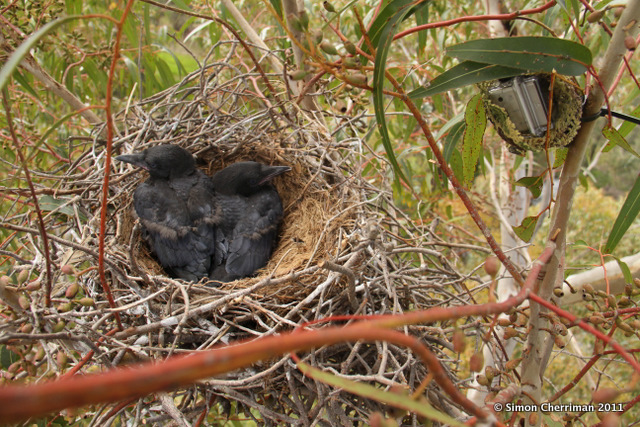
Raven Nestlings


A pair of Australian Ravens has this year nested in the top of a gum tree in our front yard.  I scaled the nest, which is 35m above the ground, to install a mini sports camera (GoPro) to record some of their behaviour.  The climb was exhilarating and the view from the nest spectacular.  I was even happier when I took the camera down and saw it had taken some of this footage...

Wednesday, 14 September 2011

Incredible Ibis!


Yesterday on the way home from Pinjarra I found an AMAZING breeding colony of Straw-necked Ibis.  HUNDREDS of birds in a tiny little swamp. One nest cluster had SIXTEEN nests in 2m squared! Such incredible animals! And in the middle of all that activity, a Black Swan nest :)
 
More photos here.